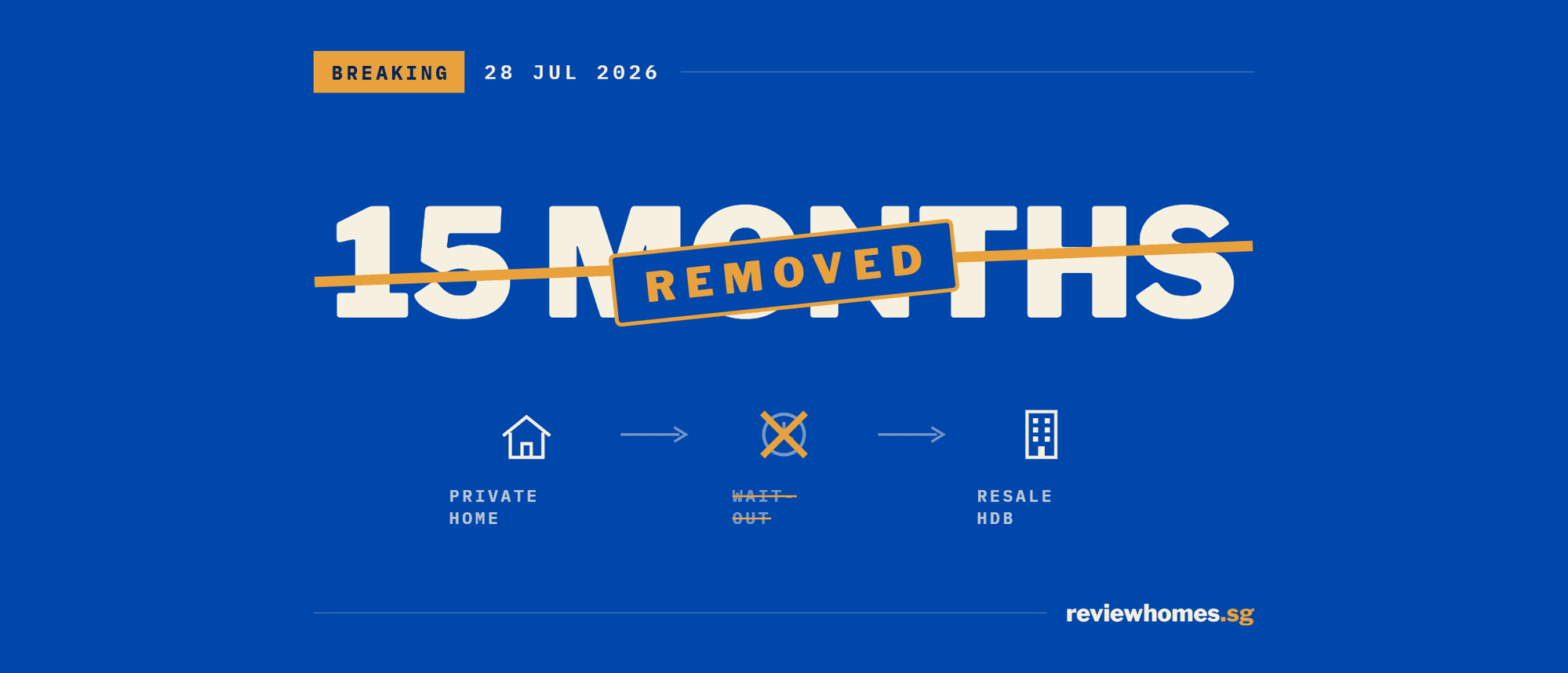
On July 28, 2026, National Development Minister Chee Hong Tat removed the 15-month wait-out period with immediate effect: private owners can buy a non-subsidised HDB resale flat without waiting, then sell their home within six months of completing. HDB fielded about 1,800 waiver appeals a year and refused three in four, so the released queue runs thousands deep. The removal lands four days after a second straight quarterly HDB price decline, with MOP supply climbing toward 19,500 flats in 2028. The condos downgraders must now sell become private resale supply, and that is where price growth cools.
Sources: MND, CNA, The Business Times, AsiaOne, HDB, URA
What just changed
This morning, July 28, 2026, National Development Minister Chee Hong Tat removed the 15-month wait-out period for private property owners buying HDB resale flats, with immediate effect. He announced it at the 11th Singapore Economic Review Conference at Orchard Hotel, and CNA carried it within the hour.
If you own a private home, or sold one recently, you no longer wait 15 months before buying a resale flat. The rule dated from the September 30, 2022 cooling package, introduced when COVID-era BTO construction delays left too many buyers chasing too few flats. The government called it temporary from day one. "As market conditions improved, we have assessed that the 15-month wait-out period has met its purpose and will be removed with immediate effect," Minister Chee said, per The Business Times.
The trigger is in the numbers he cited. HDB resale prices have moderated significantly since the start of the year: the resale price index slipped 0.1% in Q1 2026, then 0.3% in Q2, the first back-to-back quarterly declines since 2019, against growth that peaked at 10.4% in 2022. HDB published the Q2 figures on July 24. The removal came four days later.
Who skips the wait, and who still serves 30 months?
The headline is simpler than the fine print, and the fine print tells you whether this change applies to you.
| Your situation | Before July 28, 2026 | From July 28, 2026 |
|---|---|---|
| Buying a non-subsidised resale flat, no HDB loan, no grants | 15-month wait after selling private | No wait |
| Aged 55+, moving to a 4-room or smaller resale flat | Exempt since 2022 | Exempt, unchanged |
| Buying a resale flat with CPF housing grants | 30-month wait | 30-month wait, unchanged |
| Buying a subsidised flat or a new EC from a developer | 30-month wait | 30-month wait, unchanged |
| Taking an HDB housing loan | 30-month wait | 30-month wait, unchanged |
| Selling your private property after buying the flat | Within 6 months of completion | Within 6 months, unchanged |
Two details matter most. First, the removal covers non-subsidised resale purchases financed without an HDB housing loan: if your plan leans on grants or an HDB loan, your clock is still 30 months. Second, the six-month disposal rule survives. You must still sell your private home within six months of completing the flat purchase. What changed is the order of operations. Under the old rule you sold first, then spent 15 months as a non-owner, renting or moving in with family, before you could buy. Now you buy the flat while still holding the condo, move once, and sell on a six-month deadline.
If you already hold a valid HDB Flat Eligibility letter and your plans are unchanged, nothing happens to you. Applications in processing get updated automatically.
How much downgrader demand was the wait-out holding back?
The best measure the government has given us is the appeal queue. Since the measure started, HDB has processed about 1,800 appeals a year from private property owners asking to waive the wait-out. The Ministry of National Development called that number stable in a written parliamentary reply last year. HDB acceded to about 1 in 4, mainly for households in financial difficulty or extenuating circumstances with no alternative housing.
Run that across the measure's near-four-year life and it works out to roughly 7,000 appeals, more than 5,000 of them turned down. Around 1,350 households a year asked to skip the wait and were told no.
That number is a minimum, not the demand itself. You appealed only if you could argue hardship. The ordinary downgrader, the couple in their fifties looking at the HDB-condo price gap that has doubled since 2016 and wanting to cash the difference, had no grounds to appeal. They did not join the queue. They waited, rented, or shelved the plan. Fifteen months without a home is a hard sell for a family, and the measure was designed to make it hard. That is the demand released this morning, and nobody has a precise count of it. The appeal queue just tells you it is thousands deep.
The sequencing: four years of moves in one direction
Line up the moves since 2022 and the pattern is hard to miss.
| Date | Move |
|---|---|
| Sep 30, 2022 | 15-month wait-out imposed as BTO delays squeeze supply |
| 2021 to 2025 | 102,400 BTO flats launched, exceeding the 100,000 target |
| Jun 2025 | Minister Chee signals the wait-out could relax before 2027 |
| Mar 2026 | Parliament told the policy is under review, "prudent to monitor a while more" |
| Apr 1, 2026 | Q1 2026 flash estimate: first index decline in nearly 7 years |
| May 8, 2026 | EC reset: 10-year MOP, deferred payment scrapped, 90% first-timer quota |
| Jul 24, 2026 | Q2 2026 data: second straight decline, 0.3% down |
| Jul 28, 2026 | Wait-out removed with immediate effect |
The supply behind the timing is published too. HDB expects flats reaching their Minimum Occupation Period to climb from about 8,000 units in 2025 to 13,500 this year, 15,000 in 2027 and 19,500 in 2028. Another 50,000 BTO flats launch between 2025 and 2027. When we covered the Q1 decline in April, we called the BTO programme the cooling measure that worked. The MOP wave is that same programme arriving at the resale market on a five-year delay.
To be fair, we got the mechanics wrong in that April piece. We expected a staged cut to the wait-out, 15 months down to 9 or 12, and probably nothing before late 2026. The government moved in one step, four days after the second quarterly decline. We were right about the condition and wrong about the caution: they were waiting for the data, and by July the data had arrived twice.
Read the whole sequence as one design. Build supply until the index turns. Hold the gate until the decline is confirmed twice. Then release the buyers you have been holding back, at the exact moment the MOP wave arrives to absorb them. The same speech even pushed a matching move on the private side: the ABSD sales deadline for en bloc redevelopments of 700 or more units stretches to six years, and to seven years above 1,400 units. That makes the large en bloc deals we flagged in the 1H2026 land cost piece easier for developers to take on. None of this is coincidence. It is policy working in the order it was built to work.
What happens to private resale prices now?
Here is the part of today's news most coverage will skip: the wait-out was never only about HDB. Every household it held back was also a private seller in waiting.
The mechanism is the six-month disposal rule. A downgrader who completes a resale flat purchase has six months to sell their condo. So each released household converts, within months, into one private resale listing with a deadline attached. An owner on a deadline prices to sell. A market gets moderated not by how many listings sit on it but by how many owners must actually close, and this change manufactures exactly that kind of seller, steadily, through 2027.
Those listings land in the slower half of what we described in April as a two-speed market: new launches clearing 80 to 90% on opening weekends while resale units sit for months at all-time-high asking prices. More stock, plus a growing share of it on disposal clocks, is what gives private resale buyers real negotiating room.
And the relief has nowhere else to come from, because new launches cannot get cheaper. Residential GLS plots were awarded between roughly $960 and $1,625 psf ppr across 2025 and 2026, per our 2H2026 GLS guide, with the Bukit Timah Road record at $1,820 psf ppr. By 2027, an OCR launch under $2,800 psf will feel like a win. Land bought at those rates holds launch prices up regardless of how many downgraders list their condos. If private prices cool anywhere, it is resale, and resale is precisely where the downgrader condos are headed.
That said, moderate is the word, not fall. URA's private residential price index still rose 0.5% in Q2 2026. Downgraders cashing out a decade of gains are not distressed sellers, and the six-month clock only starts once a flat purchase completes, so the listings arrive as a steady flow rather than a flood. The base case is private resale price growth easing toward flat as the wave builds, with the sharpest movement in condos whose natural buyers were other upgraders all along.
What happens to HDB resale prices?
The released demand flows the other way, into the resale flat market the government just spent four years cooling. This is the calculated risk in today's move.
Downgraders carry condo proceeds, and their purchasing power is the reason the wait-out existed: in 2022 they were outbidding first-timers and pushing resale prices up. Expect the returning demand to concentrate where a condo seller wants to land, in larger, newer and more central flats. The million-dollar flat count over the next two quarters is the cleanest early signal to watch.
The government's bet is that the supply wave is bigger than the released demand. On the published numbers, the bet looks reasonable: 13,500 MOP flats this year against a released queue measured in thousands, with the wave still rising toward 19,500 in 2028. If you are a first-timer, the practical read is that competition returns at the top end of resale while the broad middle stays cushioned by MOP supply. The Q3 and Q4 index prints will tell us whether the timing was as precise as it looks. If downgrader demand re-heats the index, expect the government to reach for the same levers again.
What this means if you are moving now
If you are a private owner ready to downgrade: the path is open today. Buy the non-subsidised resale flat first, financed without an HDB loan or grants, then sell your private home within six months of completing the purchase. One move, no 15-month gap. Check which door you are walking through before you list anything: if your numbers need grants or an HDB loan, the 30-month wait-out still applies to you.
If you are selling a condo but not downgrading: more listings are coming to your market over the next year, and a growing share of them will carry six-month deadlines. If you were planning to sell anyway, listing ahead of that wave is cleaner than listing into it.
If you are buying a private resale condo: patience starts paying. More stock, more sellers who must transact, and land costs still holding new launches out of reach. The negotiating room we described in April widens from here.
If you are selling an HDB flat: your buyer pool just grew, and the new entrants arrive with condo proceeds. This matters most for larger, newer and central flats. Fresh MOP sellers keep their built-in cushion either way.
If you are a first-timer buying resale: the top end gets more competitive from today. The middle of the market is where the MOP wave protects you, and BTO remains the value path it has been throughout.
The levers, in order
Put the moves side by side and the levers line up. The BTO programme cooled HDB resale. The EC reset in May closed the fast-flip route and steered upgraders toward private homes. Today's removal releases four years of held-back downgraders into the resale flat market just as MOP supply peaks, and their condos into a private resale market that needed the stock. The stretched en bloc timelines hand developers more room to redevelop the oldest estates. Each move sets up the next one.
We will be watching three numbers through the rest of 2026: the Q3 HDB resale index, private resale listing volumes into Q4, and the million-dollar flat count. If you would rather not wait for the next long read, that is what our Telegram channel is for: the shorter updates as the market moves, between the longer reads.
We read every reply. If there is a topic you want us to cover, a condo you would like reviewed, or a property journey worth telling — your own purchase, your near-miss, or what you are holding right now and trying to decide what to do with — write to us. Some of these become full articles on the site. Some become case studies. We have turned reader questions into full guides before, and we will do it again.
Send us a topic on WhatsAppData sources: MND announcement July 28, 2026 (Minister Chee Hong Tat at the 11th Singapore Economic Review Conference), CNA, The Business Times, AsiaOne, HDB resale price index and MOP supply data, URA private residential price index Q2 2026, URA GLS tender records
Published by MJ Review Homes (reviewhomes.sg) | PropNex Realty Pte Ltd | Shaik Amar R058640H | Myra Jalil R058979B | +65 9690 5440 | +65 9738 3705