Over the past year, 1,739 HDB flats sold for a million dollars or more — concentrated in central towns, most often the ordinary 4-room flat. But that route is closing. New BTO flats in those same estates now launch as Plus or Prime: a 10-year MOP, a 6 to 9 percent subsidy clawback, and an income cap on who you can sell to. The buyers cashing out today balloted before the rules changed. For anyone buying now, a Standard 4-room in Yishun, Tengah or Jurong frees you in five years instead of ten.
Sources: data.gov.sg HDB resale data, HDB, the Prime Minister's Office, EdgeProp, DollarsAndSense
Over the last twelve months, 1,739 HDB flats sold for a million dollars or more. The number gets attention for an obvious reason. A flat bought from HDB for a few hundred thousand dollars, resold years later for seven figures, looks like the cleanest win in Singapore property.
If you are a younger buyer choosing your first flat, the pull is easy to feel: get into one of those estates, ride the same wave, cash out. Two things make that the wrong move in 2026. The headline number puts far less cash in your hand than it suggests. And the route that produced it has been closed off, on purpose, by the way HDB now classifies new flats.
Where are the million-dollar HDB flats?
We pulled every HDB resale transaction from the past twelve months and filtered for the ones at a million dollars and up. There were 1,739 of them, from May 2025 to May 2026. That works out to about 145 a month. The most expensive cleared $1.73 million. A million-dollar HDB flat is no longer a freak headline. It is a steady, ordinary event.
They are not spread evenly. The bulk sit in mature, central towns:
| Town | Million-dollar resale sales, past 12 months |
|---|---|
| Toa Payoh | 306 |
| Bukit Merah | 222 |
| Queenstown | 204 |
| Kallang/Whampoa | 147 |
| Ang Mo Kio | 123 |
| Clementi | 111 |
| Bishan | 99 |
| Tampines | 81 |
Toa Payoh, Bukit Merah, Queenstown, Kallang. These are the addresses people picture when they picture the win. Outer towns barely show up: Punggol, Bukit Panjang and Bukit Batok had around ten each.
One more detail. The 4-room flat is the single biggest group, 739 of the 1,739, ahead of 5-room and Executive flats. The million-dollar HDB flat is not some rare jumbo unit. It is an ordinary 4-room in a good location. Hold that picture, because it is the thing a younger buyer would be chasing, and it is where the rules have moved.
What does a million-dollar sale actually pay you?
Say you did exactly that. Around 2014, you booked a 4-room flat in a choice mature estate, new from HDB, for about $480,000. You collected the keys a few years later and took a 75 percent loan, the standard ceiling. In 2026, twelve years after you signed, you sell for $1.1 million. That is right in the band 4-room flats built around 2013 in towns like Bukit Merah and Toa Payoh are fetching today.
A million-one. Here is where it actually goes.
| Selling your $1.1M flat | Amount |
|---|---|
| Sale price | $1,100,000 |
| Outstanding home loan repaid | -$269,000 |
| Refunded to your CPF | -$335,000 |
| Agent commission and legal | -$25,000 |
| Cash in your bank | $471,000 |
Three things take a cut before you see anything.
The loan goes first. You borrowed $360,000 and have been paying it down for the better part of a decade, but a 25-year loan moves slowly in its early years. Around $269,000 is still owed, and that gets settled from the sale.
Then the CPF refund. Every dollar of CPF savings you put in, for the downpayment and the monthly instalments, goes back into your CPF account when you sell, along with the accrued interest those savings would have earned sitting there at 2.5 percent a year. Here that is about $335,000: roughly $277,000 of savings you used, plus $58,000 of interest you owe yourself.
Then agent commission and legal fees, about $25,000 on a sale this size.
What lands in your bank account is around $471,000. Not $1.1 million. Less than half of it.
The honest part: that CPF refund is not money lost. It sits in your CPF account, and if you are upgrading you can use it again for the next home. And you did gain. You paid $480,000 and sold for $1.1 million; even after loan interest and costs, you are ahead by roughly half a million dollars. But it took twelve years, and the cash you can actually touch the day after completion is $471,000. You sold for a million dollars. You did not pocket one.
Why can't you flip a prime HDB flat anymore?
The flat in that example was booked in 2014, and the timing is the whole story. Back then it was an ordinary mature-estate flat. Five-year minimum occupation period, and when you sold, you sold to whoever could pay, and kept the gain.
That route is closed for new buyers.
In August 2023, at the National Day Rally, then-Prime Minister Lee Hsien Loong said it plainly: a subsidised flat in a choice location "turns the BTO exercise into a lottery," and "those who are lucky enough to ballot such a flat stand to reap a windfall upon resale." The fix was a new way of classifying every new HDB flat, which started with the October 2024 BTO launch. It came from the same place as the May 2026 tightening of executive condominium rules: take the speculative edge off public housing.
Every new BTO flat is now Standard, Plus, or Prime, set by how good the location is.
| Standard | Plus | Prime | |
|---|---|---|---|
| Minimum occupation period | 5 years | 10 years | 10 years |
| Subsidy clawback on resale | None | 6-8% | 9% |
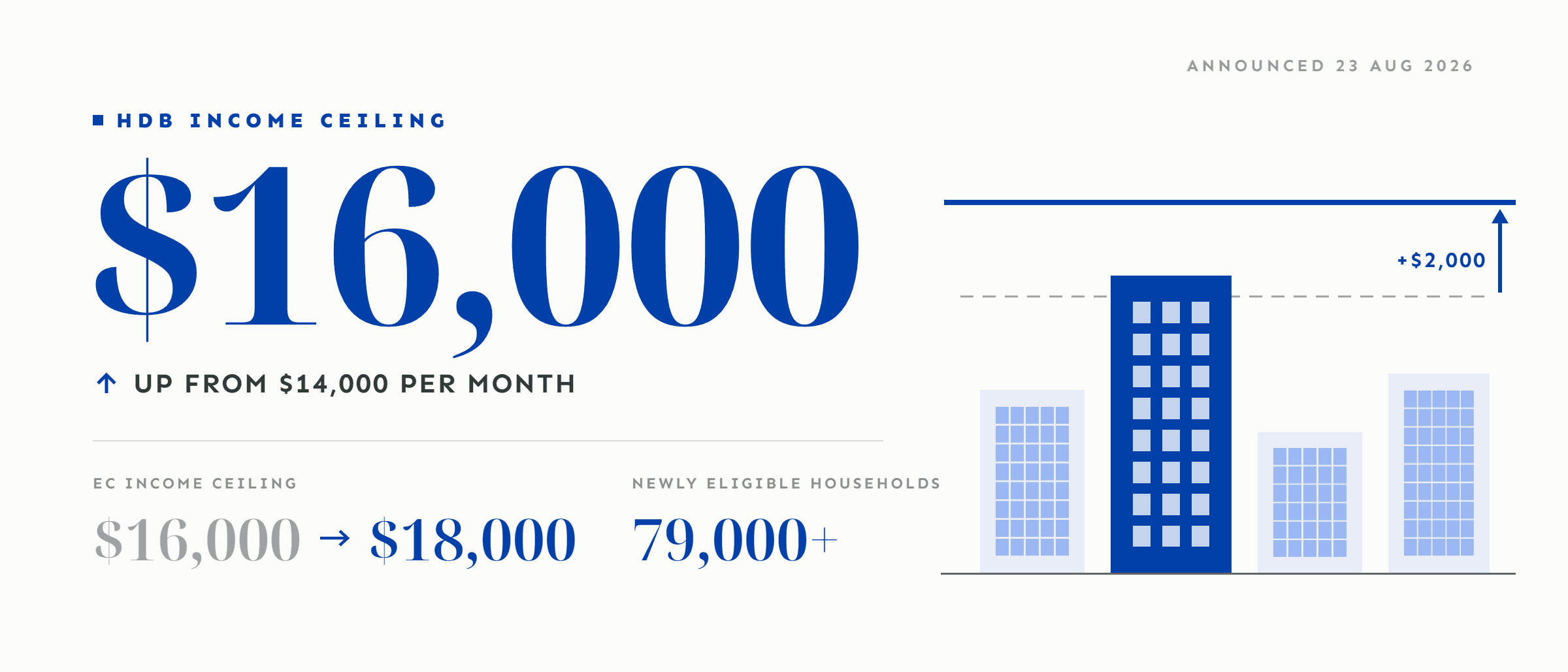
| Resale buyer income ceiling | None | $14,000/month | $14,000/month |
| Rent out the whole flat | Allowed after MOP | Never | Never |
Standard flats, the bulk of the island, keep the old terms. Plus and Prime flats, in the choicer and choicest locations, are a different deal. The MOP is 10 years, not five, so you are locked in twice as long. When you sell, HDB claws back a slice of the price: at the October 2024 launch, 6 percent for Plus and 9 percent for Prime, charged on the resale price or the valuation, whichever is higher. You can only sell to a household earning $14,000 a month or less, which caps who can buy from you and therefore how high you can price. And you can never rent out the whole flat.
Now line it up against the data. The towns where those 1,739 million-dollar flats cluster, Queenstown, Toa Payoh, Bukit Merah, Bishan, Ang Mo Kio, Clementi, are exactly the towns where new BTO flats now launch as Plus or Prime. The estates that made the windfall are the estates HDB has ringfenced.
Most people miss this part. The entry price barely moved. A 4-room in these estates cost around $480,000 as a BTO in 2014. A new Plus or Prime 4-room in the same estates today starts from roughly $490,000 to $530,000. HDB still prices them well below the resale market. That is the point of the extra subsidy. What changed is not the cost of getting in. It is the door out.
Could you still make money on a Plus or Prime flat? Probably. A Prime 4-room in Clementi launched in July 2025 at about $562,000, next to a resale flat worth $1.28 million. Even after a 6 to 9 percent clawback, a buyer there likely comes out ahead. The flat is decent value. But it is a 10-year commitment with a skimmed, income-capped exit, and that is a different thing from the quick, clean sale the 2014 buyer pulled off.
And there is one more part to this, the part that does the real damage. These restrictions are not yours to clear and leave behind. They stay with the flat. Whoever buys it from you takes on the same deal: another 10-year lock-in, the same income ceiling on who they can sell to, the same slice clawed back when they sell. A normal flat gets easier to sell as it ages, as the MOP clears and the buyer pool widens. A Plus or Prime flat never reaches that point. The exit stays narrow for every owner, in every resale, for as long as the flat stands. A buyer pool that is capped permanently is a ceiling on the price that never lifts.
Is a Yishun or Tengah flat the smarter buy?
So if a choice-location flat is now a 10-year commitment with a capped exit, what is the alternative?
The plain flat. A Standard 4-room in an outer town like Yishun, Tengah or Jurong. Every BTO launched in those towns recently has been Standard: a 5-year MOP, no clawback, no income limit on who you sell to.
Start with the entry price. A Standard 4-room BTO in Yishun, Tengah or Jurong launched from roughly $236,000 to $350,000 in the recent exercises. That is about half what a Plus or Prime 4-room costs in the central estates. You are putting far less money, and far less risk, on the table to start with.
Then the exit. Clear your 5-year MOP and you can sell to anyone, with nothing clawed back, in half the time a Plus or Prime owner is locked in.
What do you walk away with? Run the same waterfall on a smaller flat. Say you bought a Standard 4-room at $350,000 and, after the MOP, sell it for around $650,000. Newer 4-room flats in these towns can fetch that and more today, so $650,000 is a deliberately cautious figure.
| Selling a $650,000 Standard flat | Amount |
|---|---|
| Sale price | $650,000 |
| Outstanding home loan repaid | -$214,000 |
| Refunded to your CPF | -$202,000 |
| Agent commission and legal | -$16,000 |
| Cash in your bank | $218,000 |
About $218,000 in cash, with another $202,000 back in your CPF. Call it a combined $420,000 of cash and CPF you can point straight at a private purchase. It is a smaller win in dollars than the prime-flat seller's, but a faster and cleaner one. You got there in five years instead of ten, with nothing clawed back and nothing capping your buyer. A first flat that works like a springboard, not one you are married to for a decade.
One honest caveat. Resale gains in these towns are softening. HDB's resale price index slipped slightly in the first quarter of 2026, its first quarterly fall in nearly seven years, and a large batch of flats reaches MOP in 2026. A flat bought today and sold around 2032 will likely see gentler gains than the last batch did. Plan for a smaller gain, not a bigger one. The point of the simple flat was never the size of the gain. It is the speed, and the freedom to move when you want to.
The gap you actually need to cross
Speed is the whole point, and the reason sits outside the HDB market.
This week we published a piece showing that the price gap between a 4-room HDB flat and a comparable condo in the same area has doubled in ten years. In Bishan against District 20, the gap a buyer faced went from about $533,000 in 2016 to $1.095 million in 2026. Queenstown and Tampines showed the same doubling.
That gap is the thing you are actually trying to cross. Whichever HDB flat you buy, it is the springboard. The private property is the destination. And the destination keeps moving away, every year, faster than your savings grow.
This is what makes the 10-year lock-in on a Plus or Prime flat expensive in a way the price tag never shows. It is not the clawback; 6 to 9 percent is a manageable cut. It is the five extra years. Five more years locked into HDB is five more years of the condo market pulling further ahead. By the time a Plus or Prime owner is free to move, the gap has widened again.
The Standard flat further out does not beat the prime flat on the size of the gain. It beats it on timing. You clear the MOP in five years, take your cash and CPF, and make the jump to private while the gap is as small as it is going to be. Every year you wait, that jump gets harder. That has held for a decade, and nothing in the supply picture suggests it reverses soon.
What should you buy in 2026?
If you are choosing your first HDB flat now, the pull toward a million-dollar address makes sense. It is also a decade out of date.
The buyers cashing out today bought before October 2024, under rules that no longer exist. A choice-location flat today is a Plus or Prime flat: subsidised going in, but locked for 10 years, clawed back on the way out, and limited in who you can sell to. The home is fine. The timing is the problem.
The faster route is the plain one. A Standard 4-room in Yishun, Tengah or Jurong costs roughly half as much going in, frees you in five years instead of ten, and takes nothing back when you sell. The gain is smaller in dollars. It is also in your hands twice as fast, and the job of a first flat is to get you to the next one. When you do step up to private, the same discipline applies: buy one that holds its value, not just the one with the lowest sticker.
Chase the headline and you spend ten years winning a prize that turns out to be mostly your own CPF coming back to you. Buy the simple flat, clear the MOP, and move. The million-dollar HDB flat was an opportunity. It belonged to the people selling now. The opportunity in front of you is a different one.