Yes, the HDB MOP wave is hitting in 2026 to 2028. But the upgrader pipeline is loaded with proceeds, and the popular bear case looks weaker than its surface logic suggests. Stack that against six structural forces — record land cost at every H1 2026 GLS tender, en bloc money recycling at $880M scales, equity wealth flowing in via the Bank of Parents, 150,000 incoming new citizens, and Middle East capital flight to Singapore as a safe haven — and 2026/2027 prices are biased upward. The only realistic downside is a war shock that triggers Singapore job losses.
Sources: URA, EdgeProp, The Straits Times, PropNex, 99.co, Knight Frank
The setup for 2026/2027 is biased upward
The popular bear case for Singapore property in 2026/2027 leans on two ideas. The HDB Minimum Occupation Period (MOP) wave from COVID-delayed BTO completions is supposed to flood the resale market and drag prices down. And the rising cost of new launches is supposed to break the buyer pipeline, leaving developers stuck with unsold inventory. Both ideas have surface logic. Neither survives once you stack the structural forces against them.
Six things are simultaneously true heading into 2026/2027. Every GLS tender is contested by four to eight developers and breaking land-cost records. En bloc activity has restarted — Loyang Valley closed at $880 million in April 2026 and City Plaza is gunning for $970 million on its third attempt. The HDB upgrader pipeline is loaded with proceeds from the last decade of HDB price runs. Equity and crypto wealth are flowing into the housing market through what locals are calling the Bank of Parents. Singapore is targeting 150,000 new citizens over the next five years. And capital flight from the Middle East is finding Singapore as a safe haven. The only force pulling in the opposite direction is the wildcard of a Middle East war severe enough to trigger mass job losses here. That is the one scenario to watch.
The HDB MOP wave is coming, but it is not the threat people think
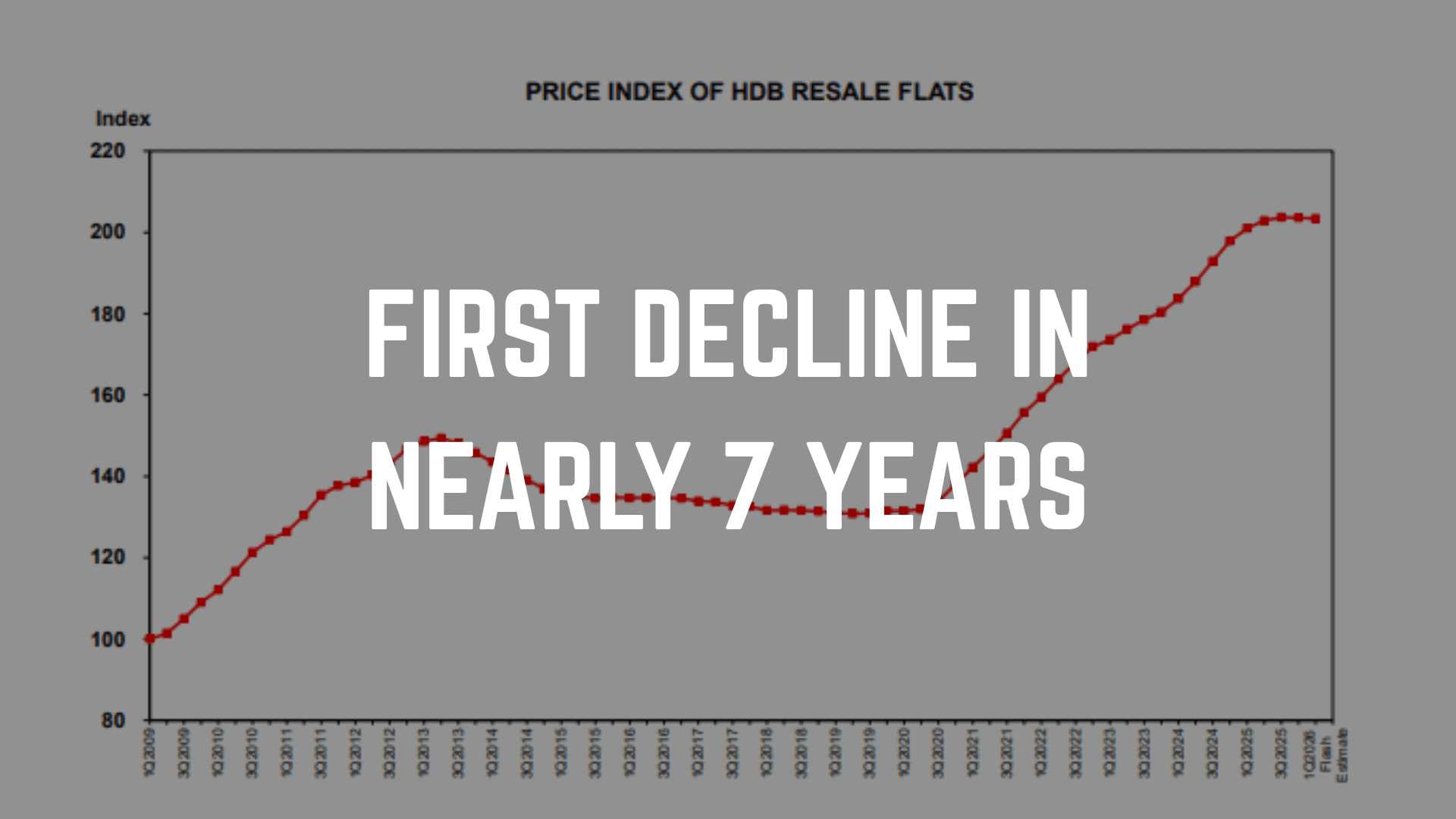
The COVID-delayed BTO bulge is hitting the market in 2026, 2027, and 2028. HDB resale prices have softened for the first time in years, as Q1 2026 numbers confirmed. The bear logic from there says HDB softness drags private prices down because upgraders cannot afford to make the jump.
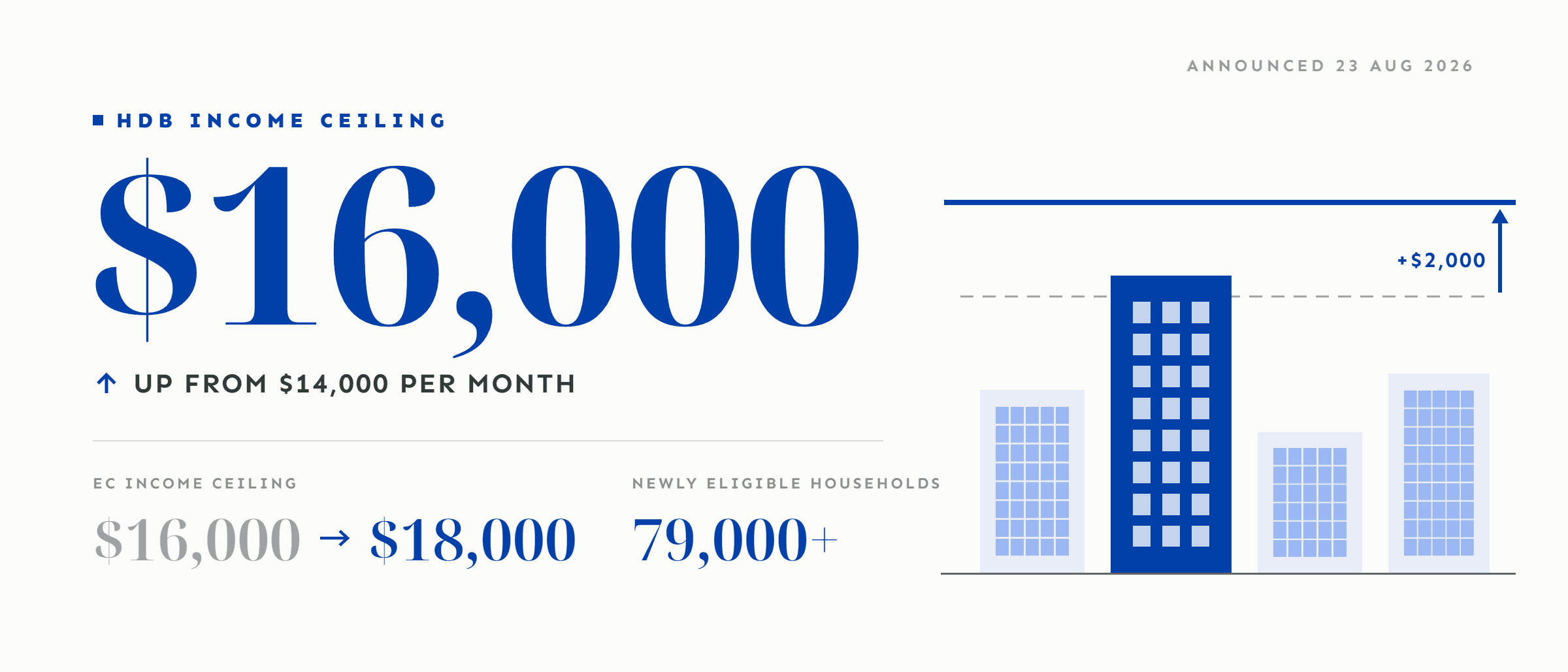
The numbers do not support that logic. A typical 5-room HDB owner who bought at around $400,000 a decade ago and is now selling at $850,000 walks away with about $600,000 in proceeds after settling roughly $250,000 in outstanding loan. That is a 70/30 cash-and-CPF mix on average. Even if HDB resale prices soften further by $40,000 to $50,000, the upgrader still walks away with roughly $550,000 — and the private upgrader path still funds a $2.1 million condo down payment without breaking sweat for a middle-income couple bringing in $15,000 to $20,000 monthly.
5-Room HDB Upgrader: Proceeds Walk-Through
| Original purchase price (10 years ago) | $400,000 |
| Current resale price | $850,000 |
| Outstanding loan balance | $250,000 |
| Net proceeds (cash + CPF) | $600,000 |
| Hypothetical HDB softening | -$50,000 |
| Adjusted proceeds (still funds 25% DP on) | $2.1M condo |
Indicative scenario based on typical Singapore HDB upgrader profile.
That liquidity is the reason the HDB MOP wave will not pull private prices down. The upgrader cohort entering the market in 2026 to 2028 is the cohort that bought HDB in 2014 to 2018 — back when 5-room flats were trading in the $400,000 to $500,000 range and 4-room units even lower. They are sitting on appreciation that comfortably covers a private down payment. HDB softness is uncomfortable for HDB sellers. It is mostly irrelevant to the private market.
Land cost is the forward indicator for 2027 launch prices
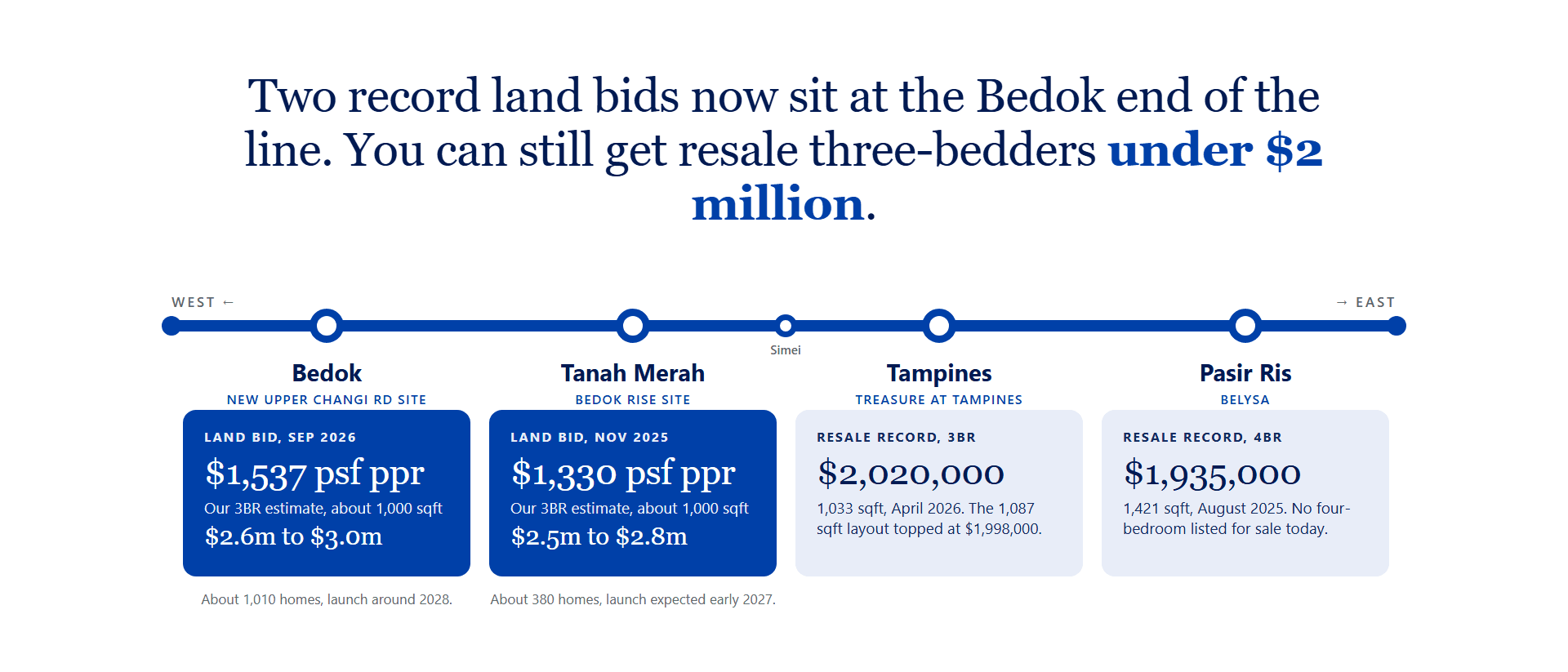
The cleanest leading indicator for 2027 launch prices is what developers are paying for land right now. Every H1 2026 GLS tender has been contested by at least four developers, with hot sites pulling six to eight bids. The 1H2026 GLS programme covers Lentor Central, Tanjong Rhu Road, Dover Drive, Bedok Rise, Dairy Farm Walk, and an EC site at Woodlands Drive 17 — about 2,750 new homes in total, ten percent fewer than the prior programme.
The winning bids set the reference price for everything that follows. Tanjong Rhu Road went to a CDL-Woh Hup JV at $1,455 psf ppr. Dover Drive went to a Qingjian-Forsea-Jianan consortium at $951 million, or $1,556 psf ppr. Lentor Central was awarded to a GuocoLand-Hong Leong-TID consortium at $657.1 million, or $1,278 psf ppr — a record bid for the Lentor estate.
Apply our standard launch psf formula of land cost x 2.23 — which captures development costs, financing, marketing, and a 20 percent developer margin — and the future-launch numbers fall out cleanly:
H1 2026 GLS — Expected Launch PSF (2027)
| Site | Land Cost | Likely Launch PSF |
|---|---|---|
| Lentor Central | $1,278 psf ppr | $2,700-3,000 |
| Tanjong Rhu Road | $1,455 psf ppr | $3,200-3,500 |
| Dover Drive | $1,556 psf ppr | $3,400-3,700 |
| Bedok Rise | TBD | $2,600-3,000 (est.) |
Launch PSF = land cost x 2.23 (development costs + 20% developer margin). Estimates only.
The downstream effect is the resale-market reset. Three-bedroom resale units that traded at $900,000 to $1 million three to four years ago no longer exist at that price. Today's lowest-hanging-fruit 3-bedder sits at $1.3 million to $1.4 million. On the current land-cost trajectory, that band is likely to push to $1.5 million to $1.6 million within the next two to three years. New launches act as a forward price anchor that pulls resale up — never the other way around.
En bloc fever is back, and it is worse than most people realise
The en bloc cycle has restarted. Loyang Valley closed at $880 million in April 2026 on its third attempt, with the public tender on Feb 10 closing without bids before private treaty drew interest from seven developers. Owners walked away with proceeds ranging from $1.67 million for a 1,001 sqft unit to nearly $3.91 million for the largest 3,272 sqft unit. The site rezones to a gross plot ratio of 1.6 under Draft Master Plan 2025 and could yield around 1,249 new homes.
Thomson View went for $810 million at $1,178 psf ppr to UOL, Singapore Land, and CapitaLand — the largest en bloc since Chuan Park. The site has been renamed Thomson Reserve and is launching in Q3 2026 at expected pricing in the mid-$2,300s psf range. City Plaza is asking $970 million on its third attempt and is hoping for CDL support. The 1972 freehold building near Paya Lebar MRT has 531 units, and the collective sales committee says the building is now contending with water leakages and frequent escalator breakdowns — the kind of operational decay that finally gets aging owners over the 80 percent approval threshold.
The compounding effect of en bloc activity is the part that does not get enough airtime. When the government sells GLS land, the proceeds go straight to national reserves and stay there. When developers buy a private collective sale, the proceeds flow back to the owners of the development — and a meaningful fraction of those owners turn around and buy their next home. If you assume even half the proceeds from a $500 million to $1 billion en bloc sale recycle back into the buyer pool, that is hundreds of millions in fresh demand pumped into the market within twelve months of each en bloc closing.
2026 En Bloc Tracker
| Site | Status | Deal Value | Buyer |
|---|---|---|---|
| Thomson View | Sold (2024) | $810M | UOL/SingLand/CapitaLand |
| Loyang Valley | Sold (Apr 2026) | $880M | SingHaiyi consortium |
| City Plaza | 3rd attempt | $970M (reserve) | CDL (anticipated) |
Owner advice: a half-decent location pushed through this year is likely to clear. Stars are aligned this cycle.
If you sit on the committee of an aging development with reasonable plot ratio headroom and any kind of locational logic, this year is the cycle to push. Big developers — Sim Lian, Kingsford, UOL — are running low on land bank and showing up at every site that hits the market. Two years from now, when the GLS programme replenishes and inventory normalises, the negotiating position swings back to developers.
The wildcards: war, capital flight, and 150,000 new citizens
The Middle East war is the wildcard nobody wants to model. Two scenarios run in opposite directions and both are live.
The downside scenario is mass job losses in Singapore. We are not immune to a global slowdown — that is a basic exposure that comes with being a small open economy — and a serious enough employment shock would push distressed sales into the market, soften prices, and reset expectations. That outcome is partly offset by the precedent of the 2020 deferred-installment policy, where the government allowed homeowners to defer principal and interest for six months during the COVID shock. A similar intervention would be on the table again if conditions warranted.
On the upside, a protracted conflict pushes energy costs higher, fuels global inflation, and drives capital toward stable safe-haven assets. Singapore real estate is one of those assets. Capital flight from Dubai and the wider Middle East — already a meaningful flow before the war — accelerates. Combined with Singapore's own population strategy of bringing in 150,000 new citizens over the next five years to address fertility shortfalls, the demographic base under demand only gets stronger. More expats renting, more PR buyers, more new citizens — all pushing on the same finite housing supply.
A third structural force most agents are quietly tracking is what locals are now calling the Bank of Parents. With US equities at all-time highs and a non-trivial cohort of crypto wealth holders in Singapore, parents who built wealth through stocks, crypto, or earlier property cycles are channeling that capital downstream — typically as down payment funding for a child's first private property, sometimes as the full purchase quantum. The effect is the same as any large wealth transfer into housing: it inflates the budget pool and supports higher transacted prices in a way that does not show up on the supply-demand spreadsheet but absolutely shows up at the cashier's counter.
What this means for buyers right now
There may be no stabilisation to wait for. The setup for 2026/2027 Singapore property is biased upward in a way that almost no recent macro period has been. Land cost is rising, GLS supply is shrinking, en bloc is recycling capital straight back into the demand pool, the upgrader pipeline is healthy, equity wealth is funding first-time private buyers, and the population strategy is reinforcing demand at the bottom of the funnel. The only realistic path down is a war-driven employment shock that may itself trigger policy intervention. That is one wildcard against six forces pushing prices up.
Asking "should I buy Singapore property in 2026" is the wrong question. Asking "what should I buy" is the right one. Pick the right unit at the right price within a comfort range that survives a stress test on interest rates and employment. Plan for a holding period that exceeds the 4-year Seller's Stamp Duty window. Avoid overstretching when so much of the upward pressure depends on macro variables that can swing without notice. Buy something safer — better location, better layout, more proven demand — rather than reaching for the maximum possible quantum.
The buyers who do well in this cycle will be the ones who treated 2026 as a year to act, not a year to time. Those waiting for HDB to drag private prices down are waiting for a chain that does not connect. Those waiting for land costs to reset are waiting for a tender programme that has stopped happening.
Where 2026/2027 lands: per-site calls and macro take
The 2026/2027 Singapore property market is biased upward. Six forces are stacked on the demand side, supply is shrinking at the GLS level, and the only realistic downside path requires a war-driven employment shock that may itself trigger government policy intervention. Buy within means, plan for a longer holding period, and stop waiting for a correction that has not materialised in two decades.
Per-development mini-verdicts:
- Lentor Central — Watch closely. At $1,278 psf ppr land cost and a record Lentor bid, expect launch psf in the $2,700-3,000 range when the project hits market in 2027. Likely to land in the price-leader role for the entire Lentor cluster.
- Thomson Reserve (former Thomson View) — Watch the showflat preview in Q3 2026. Mid-$2,300s psf launch on a $1,178 psf ppr land cost makes the developer margin tight. Demand-led pricing rather than discount pricing.
- Loyang Valley site — On a 1.6 plot ratio reset and ~1,249 unit yield, this is now a 2027/2028 OCR product. Pricing will set the new Loyang reference.
- City Plaza — The freehold mid-CCR site at Paya Lebar is the highest-impact en bloc bet of the cycle. Approval likelihood looks meaningfully better this attempt than the 2018 and 2021 rounds.
- Dover Drive — At $1,556 psf ppr, the launch formula projects $3,400+ psf in 2027, which is a structural reset for the Dover/One-North micro-market.
Data sources: Urban Redevelopment Authority (URA Government Land Sales results, January-April 2026), EdgeProp (Loyang Valley en bloc, Tanjong Rhu Road GLS, Dover Drive GLS), The Straits Times (Thomson Reserve naming, Loyang Valley closing), Yahoo News Singapore (City Plaza third attempt), 99.co (Tanjong Rhu Road GLS award), PropNex (H2 2025 GLS programme), Knight Frank (H2 2025 GLS commentary). Reviewhomes analysis uses our standard land-cost-to-launch formula of 2.23x for likely-launch psf estimates.