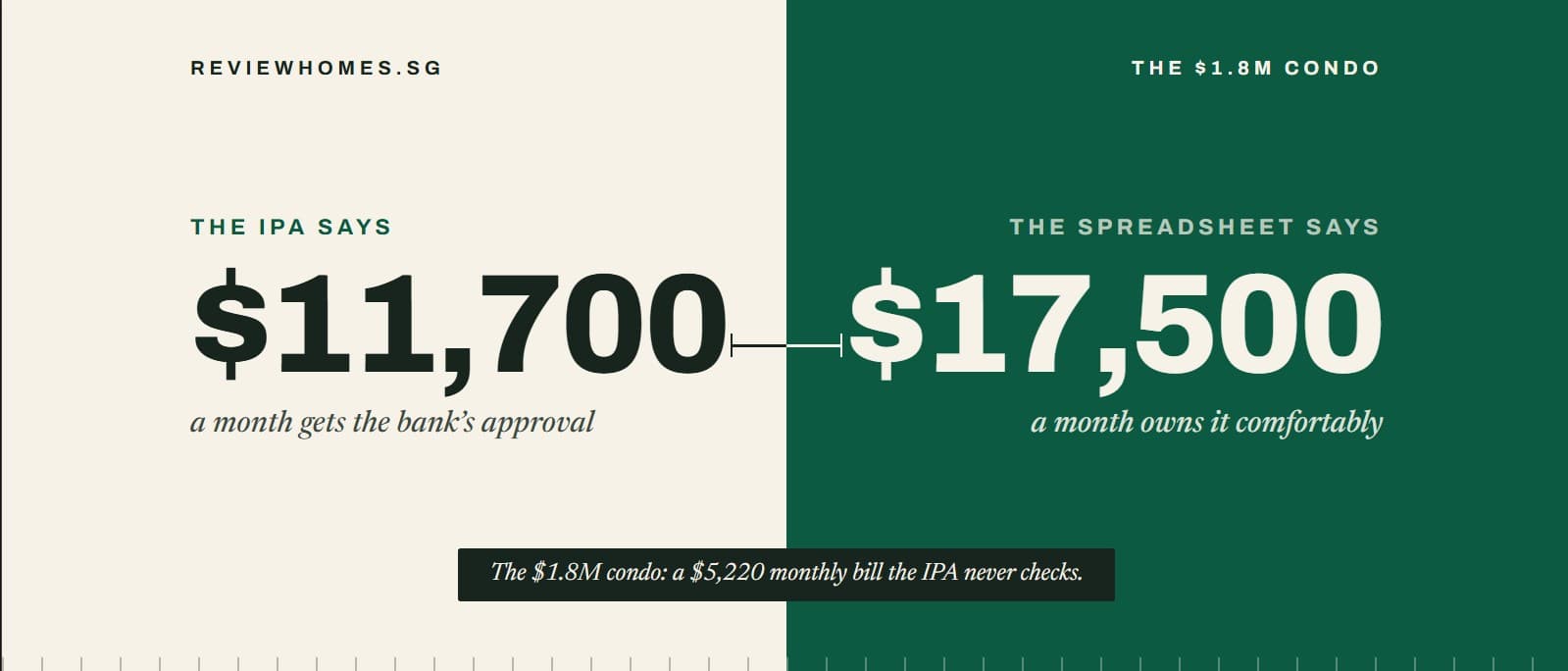
A $1.8 million condo clears bank approval at about $11,700 a month of gross income: 55% TDSR, tested at 4%, on a 30-year loan. The full monthly cost is about $5,220 at today's 1.4% rates, and close to $7,500 at 2024-level rates. Keeping it under the usual 30% of income wants a household near $17,500 a month. Mortgagee sale listings jumped 28.8% in 1Q2026, so buy on the $6,445 the bank tested you at, not the $4,595 you pay today.
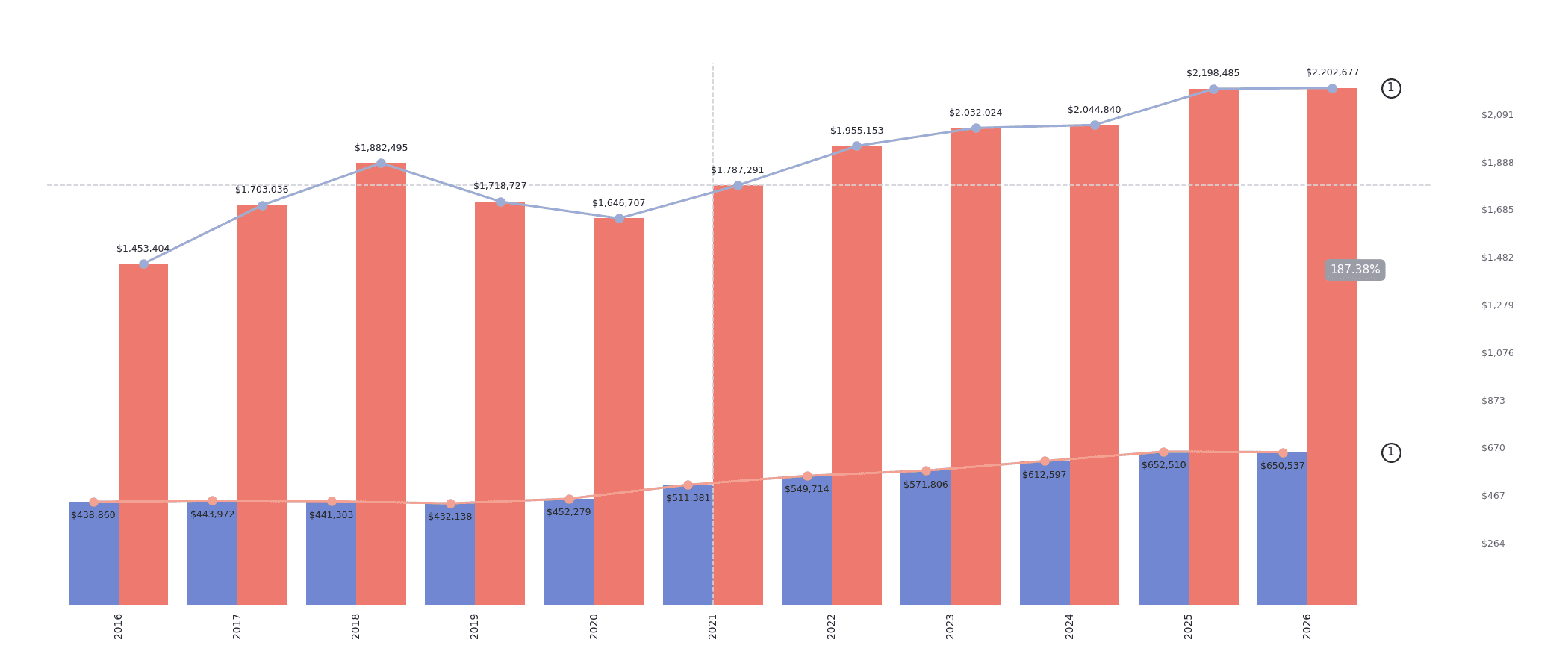
Sources: MAS, IRAS, CPF Board, EdgeProp, Knight Frank
A household earning $11,700 a month can get bank approval to buy a $1.8 million condo. That number falls straight out of the rules banks must lend by: a 55% Total Debt Servicing Ratio, tested at 4% interest, on a 30-year loan.
The in-principle approval that confirms it tells you one thing only: the most the bank is willing to lend you. It says nothing about whether you can hold that loan through a rate cycle, a retrenchment, or six months of reduced income. Those are different questions. The gap between them is where forced sales come from, and in 1Q2026 that gap showed up in the auction data.
If you are holding an IPA right now and shopping with it as your budget, start with what the IPA checked, and what it never asked.
What an IPA actually checks
An IPA is the bank's conditional yes, usually valid for around two weeks to a month. The bank looks at your gross income, your existing debts, your age and your credit record, and works backwards to a maximum loan under the TDSR rules: all your monthly debt obligations, capped at 55% of gross monthly income.
One more rule inside that calculation sets the ceiling. Since September 2022, MAS requires banks to compute your instalment at the higher of 4% or the actual package rate. Your real mortgage today might be priced near 1.4%. Your approval was sized at 4%.
Here is the full worked example for a $1.8 million private condo purchase, on a sample profile we will use through this piece: a couple buying their first private property, 30-year loan, no other debts.
| The approval arithmetic | Figure |
|---|---|
| Purchase price | $1,800,000 |
| Loan at 75% LTV, 30 years | $1,350,000 |
| Monthly instalment, tested at 4% | $6,445 |
| Minimum gross household income at 55% TDSR | $11,718 a month |
| Down payment (25%) | $450,000 (at least $90,000 in cash) |
| Buyer's Stamp Duty | $59,600 |
The "no other debts" line is the one to watch. Add a $1,200-a-month car loan and the same income approves a loan of about $1.10 million instead, which drops the purchase budget from $1.8 million to roughly $1.46 million. The car costs you $335,000 of condo.
But read the table again from the bank's side. TDSR exists to protect the lending book. It asks one question: will this borrower probably keep paying? It is not built to answer the question you actually have, which is whether the payments leave you a life.
What a $1.8 million condo costs every month
Mortgage rates in July 2026 are the lowest since 2021. Fixed packages start around 1.40% and floating packages from about 1.3%, per PropertyNet.SG's rate tracker, with 3-month compounded SORA at 1.12% as of 9 July. At a 1.4% fixed rate, the monthly costs on our sample purchase look like this.
| Monthly cost, July 2026 rates | Figure |
|---|---|
| Mortgage ($1.35M, 30 years, 1.4% fixed) | $4,595 |
| Maintenance fees (MCST) | ~$400 |
| Property tax (owner-occupier) | ~$227 |
| Total | ~$5,220 a month |
Two notes on the smaller lines. Maintenance fees for a mid-size condo typically run $300 to $700 a month depending on unit share value and facilities. We have used $400 for a standard 3-bedroom. Property tax uses IRAS owner-occupier rates on annual value, which is pegged to market rent. A condo in this price range rents at roughly $5,000 a month, putting annual value near $60,000 and the tax at about $2,720 a year.
Now the part many buyers skip: how much of this can ride on CPF. Ordinary Account inflow is capped by your allocation rate and the $8,000 CPF salary ceiling: for a worker aged 35 and below, about 23% of wages, or a maximum of $1,841 a month. Two earners both at the ceiling put $3,682 a month into OA, which still leaves $913 of the mortgage in cash. And the maintenance fees and property tax never touch CPF at all. Even a maxed-out CPF household pays around $1,550 a month in cash for this condo. Our couple at $11,718 gross is not at the ceiling, so their cash portion is higher.
The same loan at 2024 interest rates
A 30-year loan does not live at one rate. Most fixed packages run two years. After that you refinance into whatever the cycle is doing, and the cycle has swung hard recently. 3-month compounded SORA sat near zero through 2021, averaged about 3.5% to 3.6% across 2024 per historical SORA data, and has fallen back to 1.12% in July 2026.
The same $1.35 million loan, at the rates the last cycle visited:
| Interest rate | Monthly instalment | vs July 2026 |
|---|---|---|
| 1.4% (July 2026 fixed) | $4,595 | — |
| 2.5% | $5,334 | +$739 |
| 3.5% | $6,062 | +$1,467 |
| 4.5% (roughly the 2023-24 cycle peak) | $6,840 | +$2,245 |
| 5.5% | $7,665 | +$3,070 |
This is why the 4% test rate exists. Buyers who locked in fixed rates near 1.10% in mid-2021, per MortgageWise's rate cycle records, came off those packages two years later into a market where floating rates ran past 4%. Their instalment on a loan this size rose by more than $2,000 a month between renewal letters.
That said, nobody is forecasting an immediate repeat. PropertyGuru's 2026 rate outlook has analyst forecasts clustering between 0.7% and 1.2% SORA for the rest of the year. But a 30-year loan will outlive every forecast you can read today, and the last full cycle took payments up 49% in two years. If your budget only works at 1.4%, you do not have a budget. You have a bet on rates.
Six months at 70% income
The brief stress test banks do not run for you: what happens to this household if income drops 30% for six months. A retrenchment with a slow re-hire, a commission year that misses, one earner stepping out for a parent or a child. Common enough that you should price it.
Our couple grosses $11,718. After 20% employee CPF contributions, take-home is about $9,374 in cash, with roughly $2,696 a month flowing into OA. At today's rates housing takes $5,220, of which OA covers $2,696 of the mortgage, leaving about $2,525 in cash. That leaves them roughly $6,850 of cash a month for everything else: food, transport, insurance premiums, parents, children, savings. It works.
Cut income 30% for six months and the same sums look like this.
| Six months at 70% income | At 1.4% rates | At 4.5% rates |
|---|---|---|
| Gross household income | $8,203 | $8,203 |
| Cash take-home | $6,562 | $6,562 |
| Housing cash needed (after CPF) | ~$2,840 | ~$4,980 |
| Left for all other living costs | ~$3,720 | ~$1,580 |
At today's rates the household squeezes through, if their non-housing spending can compress below $3,700 a month. If the same income shock lands in a 4.5% rate environment (which is where this exact loan was priced eighteen months ago), the couple has $1,580 a month left to run the rest of the household. The shortfall comes out of savings at several thousand dollars a month. Right after $510,000 of those savings went into the down payment and stamp duty.
This is the sequence behind the auction numbers. Knight Frank counted a 28.8% quarter-on-quarter jump in mortgagee sale auction listings in 1Q2026, and expects more. The pattern was already building: 83 mortgagee listings in 1Q2025, up 23.9% from the quarter before, which Knight Frank attributed to the delayed bite of 2023-24 interest rates. A forced sale is rarely one event. It is a purchase made at the TDSR ceiling, then a rate renewal, then an income gap, in that order.
One more cost waits for anyone forced out early. Sell within the first four years and Seller's Stamp Duty takes another 4% to 16% of the sale price, on top of whatever the market is doing that quarter.
Buy on the 4% payment, not the 1.4% one
None of this says don't buy. The HDB-to-condo price gap doubled in ten years, and waiting has been the more expensive choice for most of the last decade. The point is narrower: the IPA ceiling and your budget are two different numbers, and smart buyers price the second one themselves.
Three checks do most of the work.
First, run your own budget at the bank's own stress rate. The instalment the bank tested ($6,445 on this loan) plus the $630 of running costs is the payment you should be able to live with, not the 1.4% teaser version. Under the common 30%-of-gross guideline, the full monthly cost at today's rates wants a household income near $17,500. The TDSR minimum was $11,718. The distance between those two numbers is how much of your IPA you should consider spending.
Second, count your cash after completion, not before. Six months of the full monthly cost at 2024-level rates is about $45,000. If paying the $450,000 down payment and $59,600 of stamp duty empties the account below that, the price is too high for the savings, whatever the IPA says. For upgraders, the cash that actually comes out of an HDB sale is usually less than the headline price suggests, so run that number before committing it.
Third, treat the approval as a limit, not a target. The buyers we see hold through bad quarters comfortably are the ones who bought $200,000 to $300,000 under their ceiling and kept the difference liquid. The ones who stretch to the last approved dollar are betting that the next six years contain no rate cycle and no bad year — a bet the current market direction gives you no reason to make when rates are at their friendliest since 2021.
The IPA answers the bank's question. The condo you can hold through 2032 is yours to size. Once the budget is honest, picking the right unit within it is the easier half of the job.