Four forces converged on Singapore property in May 2026: EC cooling (10-year MOP, no DPS, 90% first-timer quota), a 1H2026 land cost reset implying future OCR launches at $2,600-3,100 psf, Gulf wealth flight into Singapore as a safe haven, and an immigration target of up to 70,000 new citizens and PRs annually against a record 27,500-birth low. The realistic buyer alternatives narrow to three paths: private condo resale by price band, the last EC GLS sites tendered before May 8, and entry-level new launches still priced on old land cost.
Sources: MND, URA, The Straits Times, Reuters via Mothership, IDN Times, PropNex, The Business Times
Four headlines in the same month, one story
May 2026 carried four headlines you probably parsed as separate stories — but they connect.
MND extended the EC minimum occupation period from 5 to 10 years, scrapped the deferred payment scheme, and rebuilt the first-timer quota to 90% across a 24-month priority window. The 1H2026 Government Land Sales programme handed down land-cost records at every major plot — Lentor Central at $1,278 psf ppr, Tanjong Rhu Road at $1,455 psf ppr, Dover Drive at $1,556 psf ppr, Bukit Timah Road at $1,820 psf ppr. The Middle East conflict expanded into direct attacks on Dubai, and major Reuters-wired reporting confirmed wealthy Asian and Middle East asset holders are actively shifting capital toward Singapore as a safe haven. And Deputy Prime Minister Gan Kim Yong tabled a population update on February 26: up to 70,000 new citizens and PRs annually over the next five years to offset a record 27,500-birth low.
Each story has its own analyst takes. Stacked together, they form a single setup: four separate forces are pushing Singapore property the same way, and the alternatives for buyers are narrower than they look. Each of the four forces below has its own dedicated commentary if you want to go deeper. What follows connects them, then maps the three paths you can take.
Force 1: How does EC cooling kill the upgrader shortcut?
Minister Chee Hong Tat's May 8, 2026 announcement is the most material reset to the executive condominium scheme since the programme launched in 1995. The headline change is the doubling of the MOP from 5 to 10 years. Buyers of new ECs now wait a full decade before they can sell, rent out the whole unit, or buy another residential property. Full privatisation moves from year 10 to year 15.
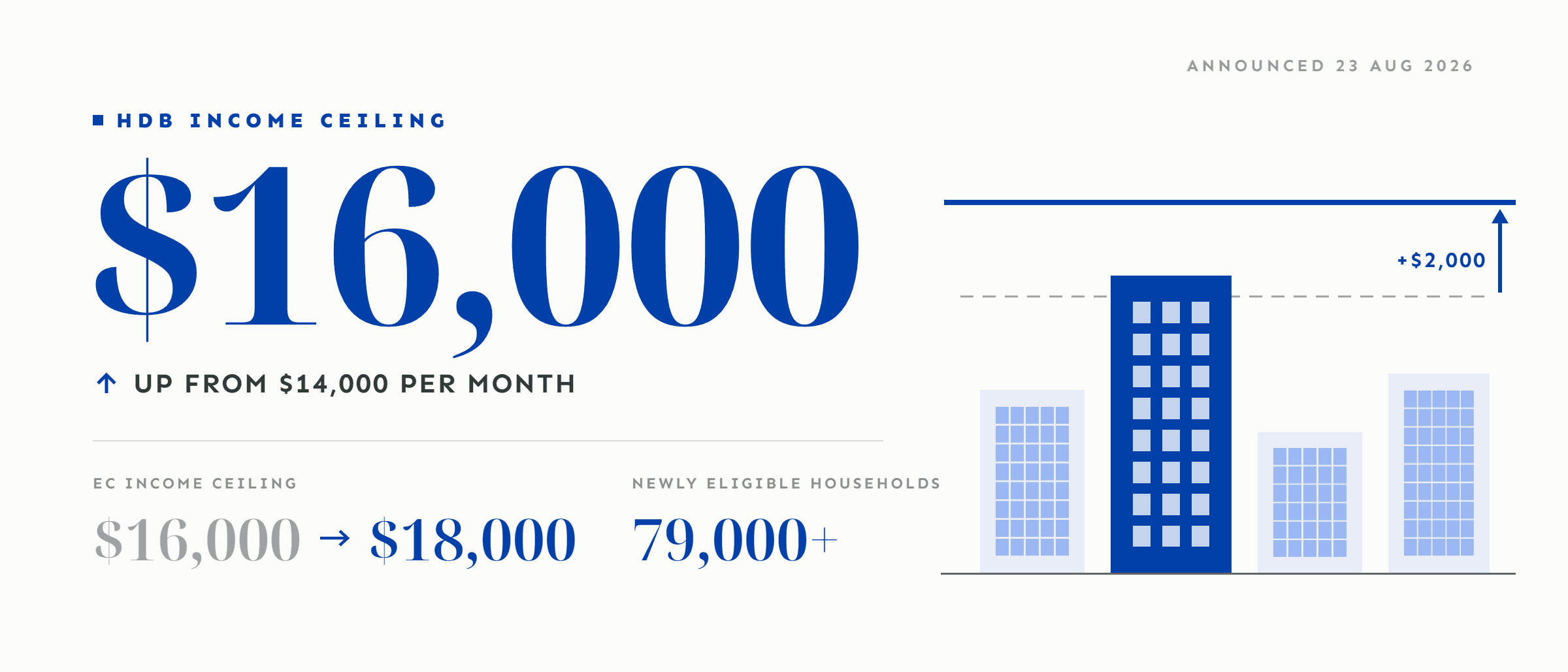
Three other levers landed alongside it. The deferred payment scheme is scrapped, removing the financing stretch that let some buyers reach into larger units. The first-timer quota lifts from 70% to 90% of units. And the first-timer priority period stretches from 1 month to 2 years. The income ceiling stays at $16,000 a month.
The effect: ECs become an owner-occupier product, not an upgrader flip cycle. The closest precedent is HDB's own Prime and Plus flats, which carry the same decade-long lock. Demand for some of them has already turned muted: first-timers have weighed the 10-year MOP and stepped back — three-room flats at the Prime project Redhill Peaks drew a first-time application rate below one, and the Plus project Kim Keat Crest came in undersubscribed, even as four-room flats in the same area stayed oversubscribed. A decade is long enough that the restriction itself reshapes who is willing to buy in the first place. Second-time buyers, the typical HDB upgrader sitting on sale proceeds, are crowded out of new EC launches for the first 24 months. The cleanest read on this lever is in our full EC cooling measures commentary, which walks through who wins, who loses, and how Canberra Drive and Sembawang Drive will be the first two test plots.
The downstream implication for this article: the EC route as a 5-year flip-and-upgrade shortcut is gone. If you were planning to use that pathway, the alternatives section below maps out the three options you have left.
Force 2: How is rising land cost resetting future launch prices?
The clearest forward indicator for 2027/2028 launch prices is what developers are paying for land right now. The 1H2026 Confirmed List delivered a clean stack of new records. Lentor Central went to a GuocoLand, Intrepid Investments and TID consortium at $1,278 psf ppr, a record for the Lentor estate. Tanjong Rhu Road went to a CDL-Woh Hup JV at $1,455 psf ppr. Dover Drive went to a Qingjian-Forsea-Jianan consortium at $1,556 psf ppr. Bukit Timah Road, awarded back in November 2025 to HH Investment at $1,820 psf ppr, set the second-highest GLS land rate in Singapore history.
Run the standard developer launch formula (land cost x 2.23, which captures roughly 72% development and financing costs plus a 20% margin) and the future-launch numbers fall out cleanly:
| Region | Old Land Cost (current launches) | New Land Cost (1H2026 GLS) | Implied Launch PSF |
|---|---|---|---|
| OCR | $1,000-$1,300 psf | $1,200-$1,400 psf | $2,600-$3,100 |
| RCR | $1,300-$1,500 psf | $1,400-$1,500 psf | $2,900-$3,300 |
| CCR | $1,800-$2,100 psf | $1,820 (Bukit Timah Rd) | $3,400-$3,900 |
The reset is 30-50% above where the current cycle of launches is priced. For deeper plot-by-plot breakdown, see our 1H2026 GLS land cost squeeze commentary. The implication for this article: every new launch from the 1H2026 GLS sites (Bayshore Drive, New Upper Changi Road, Bedok Rise, Berlayar Drive, Peck Hay Road, Holland Plain, River Valley Green, Lorong Puntong) will price into the new-land-cost regime when they hit market in late 2027 or 2028. The current cycle is the last one priced on old land cost.
Force 3: Why is Gulf wealth flowing into Singapore as a safe haven?
The Iranian drone attacks on Dubai in early March 2026 changed the safe-haven calculation for a meaningful cohort of Middle East and Asian wealth managers. Reuters reporting picked up by Mothership and IDN Times confirmed that wealthy Asian investors holding assets in Dubai are actively shifting funds to Singapore and Hong Kong, with reported individual flows exceeding US$100,000 per shifted account. The Straits Times piece on March 7 framed Singapore as a "major beneficiary" of the Gulf capital flight, with private banking, family office, and prime-residential vehicles all named as the receiving channels.
The relevant property impact concentrates at the top of the market, namely CCR prime residential and luxury family-office allocations to Singapore real estate. That is not directly the OCR mass-market launch pool. But the safe-haven shift does two things to the broader market. First, it strengthens the bid for CCR launches, which then pulls RCR and OCR pricing higher through the standard ladder effect. Second, it shifts buyer psychology. When wealthy foreign capital is publicly confirmed as flowing toward Singapore property, domestic buyers stop waiting for a correction that the structural picture no longer supports.
That said, this is the force most likely to push prices higher than expected. Gulf capital flight tends to be sticky. Once a wealth manager decides Dubai is no longer reliably stable, the reallocation is not reversed inside a single political cycle. The 2026/2027 outlook commentary tracks the broader macro setup and explains why the Middle East flow stacks with HDB upgrader liquidity and Bank-of-Parents wealth transfer to provide the baseline demand under the current market.
Force 4: What happens when immigration meets a record-low birth rate?
The fourth force is demographic, and the framing matters. Deputy Prime Minister Gan Kim Yong announced plans to admit 25,000 to 30,000 new citizens annually over the next five years, alongside roughly 40,000 new PRs each year, a total potential intake of up to 70,000 people per year. The same announcement noted that 2025 recorded approximately 27,500 resident births, the lowest in Singapore's recorded history.
The framing in the official release was explicit: immigration is being used to stabilise the citizen population against the birth rate decline. The fertility line has been declining for over a decade, and policy levers on the supply side (preschool subsidies, baby bonuses, parental leave) have not produced the desired reversal. The government's response is the more immediate one: bring in people.
The housing implication compounds over years. Over the next five years, the policy implies a net inflow of roughly 350,000 new citizens and PRs into a country where the resident-occupied housing stock grows by perhaps 15,000-20,000 net units annually. Even allowing for household sharing, foreign worker dorm differentials, and BTO absorption, that scale of population growth translates into thicker rental demand, more PR-tier buyers entering the resale and OCR new-launch pools, and stronger demographic support under entry-level private pricing. This force compounds with the others rather than offsetting them.
What the four forces imply: three buyer-side predictions
Stacked together, the four forces produce three predictions that the rest of this piece maps against actual buyer alternatives.
First, the EC market loses appeal as a primary upgrader pathway. The 10-year MOP, the scrapped DPS, and the 24-month first-timer-only window remove the speed, the financing flexibility, and the second-timer access that made ECs the default upgrader product for the last decade. Most upgraders will not wait 24 months for residual EC inventory. They will redirect to private new launches and resale.
Second, the market finds alternatives: three of them, and only three at scale. Private condo resale across the major price bands. The last EC GLS sites tendered before May 8, the existing inventory still operating under the previous 5-year MOP framework. And entry-level new launches still priced on old land cost, where the developer secured the site before the 1H2026 land-cost reset.
Third, lower entry-tier new launches will absorb the displaced demand. The four new launches still in old-land-cost territory (Lucerne Grand, Narra, Lentor Gardens, and Canberra Crescent) sit between the old pricing regime and the new one. They are the last sub-$2,200 psf OCR entry tier available before the new-land-cost launches reset the entry price. Buyers who picked the EC route for value have a natural rotation into this pool over the next 12-18 months. There is a second-order effect here too: when land costs step up, the bottom of the base tends to move fastest. The cheapest entry tiers do not just absorb displaced demand — they are usually the first to appreciate, which is why the lowest-hanging fruit so often returns the most.
The next three sections take each path in turn.
Path A: Which private resale condos fit each price band?
The cleanest alternative for buyers who want a stand-alone private property is resale. Asking prices have lifted across most segments (the 2026/2027 outlook piece walks through how rising new-launch prices have pulled resale up), but actual transaction prices are more negotiable than the headline asking suggests. Selective shoppers willing to walk multiple units in the same development typically find one priced 5-8% below the average for that development.
The four price bands below cover the realistic mid-market resale opportunity set as at late May 2026. Asking prices are listed-as-advertised on PropertyGuru at the time of writing and are subject to change. Condo names link through to their dedicated review article on this site as those reviews publish.
$1.5M band
| Development | Location | Asking Price |
|---|---|---|
| Prive | Punggol Field | S$1,540,000 |
| Waterwoods | Punggol Field Walk | S$1,588,000 |
| FLO Residence | Punggol Field Edge | S$1,600,000 |
The $1.5M band sits squarely inside HDB-upgrader reach. The Punggol area benefits from the maturing of the entire estate over the last decade: MRT access, the Punggol Digital District build-out, and a deeper amenity base than the original 2010-era launch pricing reflected.
$2M band
| Development | Location | Asking Price |
|---|---|---|
| Waterwoods | Punggol Field Walk | S$1,899,000 |
| FLO Residence | Punggol Field Edge | S$1,888,888 |
| D'Nest | Pasir Ris Grove | S$2,000,000 |
The $2M band typically delivers a larger unit type in the same Punggol/Pasir Ris area, often a 3-bedroom rather than the entry 2-bedroom that the $1.5M band tends to offer. D'Nest sits in the East with a slightly different demand depth from a buyer pool that includes Changi-area expat renters and East Coast lifestyle buyers.
$2.5M band
| Development | Location | Asking Price |
|---|---|---|
| Thomson Impressions | 3 Lorong Puntong | S$2,395,000 |
| The Panorama | Ang Mo Kio Ave 2 | S$2,300,000 |
| Treasure at Tampines | 37 Tampines Lane | S$2,380,000 |
At $2.5M, the buyer steps into a different geography. Thomson Impressions sits inside the Bright Hill / Upper Thomson corridor, with the TEL line and a strong school cluster pulling family demand. The Panorama is a long-established name in the Ang Mo Kio mature estate. Treasure at Tampines is the mega-development on this list: larger scale, deeper resale liquidity, and a unit-type spread that lets buyers find the layout that fits.
$3M band
| Development | Location | Asking Price |
|---|---|---|
| Bartley Residences | 1 Lorong How Sun | S$2,860,000 |
| Parc Esta | 900 Sims Avenue | S$2,800,000 |
| Treasure at Tampines | 31 Tampines Lane | S$2,890,000 |
The $3M band shifts the buyer into RCR-edge geographies: Bartley Residences at the Bartley MRT doorstep, Parc Esta on the Eunos / Geylang stretch with Paya Lebar's redevelopment coming online over the longer cycle, and the larger Treasure at Tampines unit configurations. At this price, the buyer competes for sky-tier units and 4-bedroom layouts rather than entry stacks.
The point of presenting the resale alternative this way is not to argue that resale is cheaper than new launch. It is not, in the headline-asking-price sense. The point is that resale gives the buyer immediate possession, no construction wait, no developer marketing premium, and direct access to specific unit attributes (stack, floor, view, layout) that a new launch only reveals at showflat. For displaced EC upgraders, that combination is materially more attractive than waiting 24 months for residual EC inventory.
Path B: Which ECs were tendered before the May 8 cutoff?
A narrower but real alternative is the last batch of EC GLS sites whose tender closing dates fell before May 8, 2026, the cutoff for the new cooling measures. These projects will be built and sold under the previous 5-year MOP framework, with the deferred payment scheme still available and the 70%-after-1-month first-timer quota structure intact.
The current short list:
Each site will be the subject of its own GLS analysis on this site as the developer line-ups and launch timing firm up. The shared trait is that whichever projects emerge from these plots will be the last few new ECs sold under the pre-cooling rules, a window that closes once these batches sell through and the next EC supply cycle arrives under the 10-year MOP, no-DPS regime — and with the earliest new-regime EC launches not expected until 2028 or 2029, that gap is wider than the calendar suggests.
One related dynamic: existing resale ECs that have already cleared their MOP are likely to see firmer demand over the next 12-18 months. Anyone who already owns an EC under the previous 5-year framework is unaffected by the new rules, and the supply of new ECs available to second-timers shrinks materially from 2027 onward. The cleaner post-MOP resale EC pool becomes the natural alternative for upgrader households that want the EC product without the wait. Expect asking prices on well-located, well-laid-out resale EC units to firm up through the year.
Path C: Which new launches are still priced on old land cost?
The third alternative is the small group of upcoming new launches whose land was secured before the 1H2026 reset. These projects sit between the cycle of old-land-cost pricing and the cycle of new-land-cost pricing that begins with the 1H2026 GLS sites.
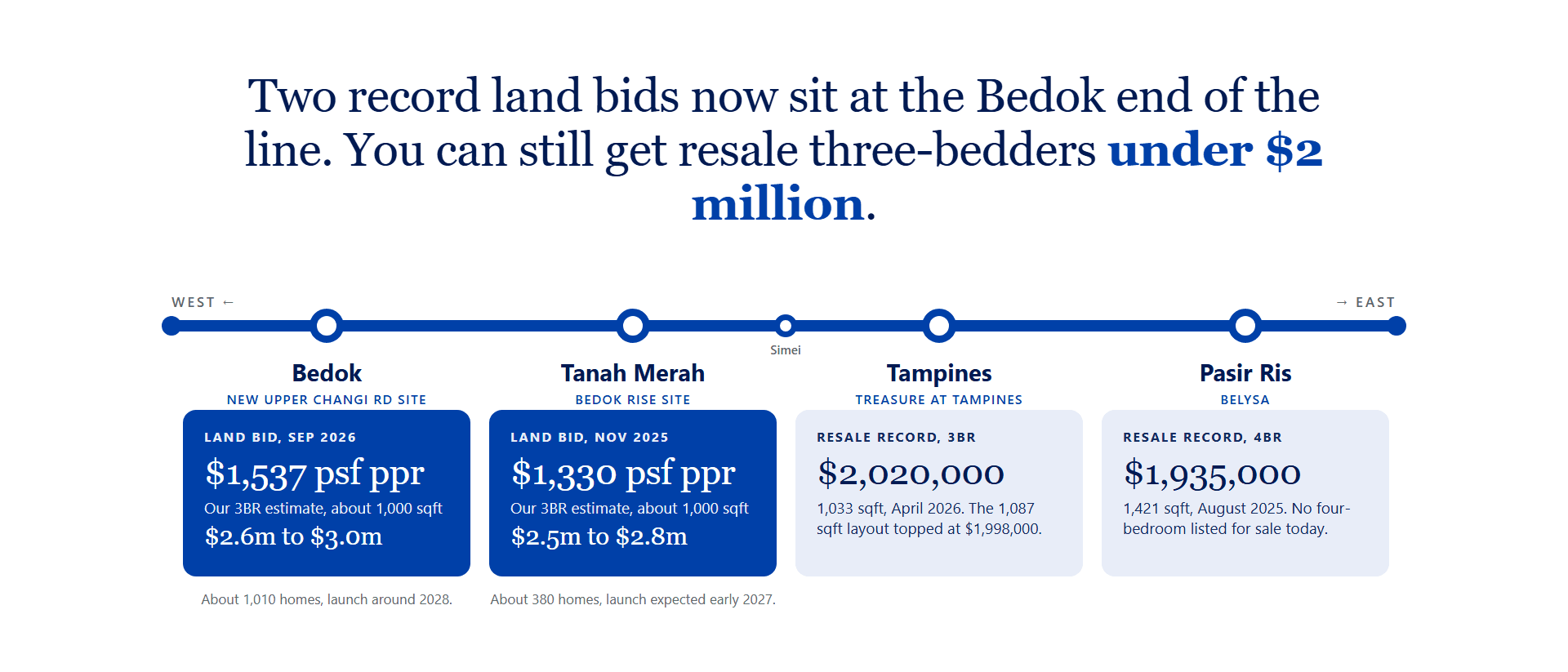
What draws attention to this group is that they are likely the last batch of OCR new launches with sub-$2,200 psf entry tiers for the next 24-36 months. Once these clear, the next round of OCR new launches comes from the 1H2026 GLS sites (Bayshore Drive, New Upper Changi Road, Bedok Rise), and those will price into the $2,600-$3,100 psf range implied by the new land cost.
Narra, in particular, is positioned as the cheapest new launch in the west — the cleanest exit story of the group, aimed squarely at west-side upgraders who would otherwise have no comparable entry point. The east has its own version of this, at a higher tier: Parktown Residence in Tampines. The land was secured in 2023, so it sits firmly on the old-land-cost side of the line, and its 4-bedroom layouts run up to 1,496 sqft — a real step up from the compact 4-bedders in older Tampines condos. That size is what pulls both HDB upgraders and existing Tampines condo owners into a 1,120-unit integrated development.
A note on pricing: specific launch psf and balance-unit prices for the four projects above tend to lag in any publicly scrapeable data, and online listings can run several weeks behind the developer's actual price list. Confirm directly with the relevant marketing agent before locking a unit. The point is that the entry tiers in this batch are the cheapest OCR new launches likely to be available before the new-land-cost regime takes over.
What to watch, what to do
The four forces are not waiting for analyst consensus. EC cooling is already in effect for every GLS site tendered on or after May 8. Land cost is already rebased: every 1H2026 plot has either closed or will close inside the next two months. Gulf capital flight is already happening, with reported individual flows above US$100,000 per shifted account. Immigration policy is already published with five-year targets.
What buyers are deciding now is which path they actually take.
For first-time buyers under $16,000 household income, the new EC regime is the most first-timer-friendly environment since the early 1995-era days of the scheme. The 90% quota and 24-month priority period materially improve access to whichever projects emerge from the Canberra Drive and Sembawang Drive tenders. The 10-year MOP is not a constraint for a family that genuinely wants to live in the unit for the medium term.
For HDB upgraders sitting on sale proceeds and looking at the EC route as a 5-year flip cycle, that route no longer exists at the new-EC level. The realistic alternatives are private resale at the four price bands above, one of the five pre-cooling EC sites on Path B, or one of the four entry-level new launches on Path C.
For higher-quantum buyers tracking the safe-haven flow into Singapore, the upper end of the CCR launch pool (and the upper end of the RCR resale pool) should firm up over the next 12-18 months as foreign wealth allocations continue. Domestic buyers competing at that tier should plan to act inside that window rather than after it.
The common thread across all three buyer paths is that the next 6-12 months is the last window of old-land-cost pricing in OCR and RCR. After the 1H2026 GLS sites translate into launches in late 2027 and 2028, the new entry price is set. Waiting through that window is not a strategy that the setup rewards. Picking the right path inside it is.
We read every reply. If there is a topic you want us to cover, a condo you would like reviewed, or a property journey worth telling — your own purchase, your near-miss, or what you are holding right now and trying to decide what to do with — write to us. Some of these become full articles on the site. Some become case studies. We have turned reader questions into full guides before, and we will do it again.
Send us a topic on WhatsAppData sources: Ministry of National Development (May 8, 2026 announcement), URA GLS 1H2026 results, The Straits Times "Singapore a major beneficiary as the wealthy move money out of troubled Gulf" (March 2026), Mothership ("Wealthy Asians looking to move assets out of Dubai due to conflict, S'pore a destination: Reuters", March 7, 2026), IDN Times ("Dubai attacked, Asian investors anxiously move funds to Singapore", March 9, 2026), MND population announcement, PropNex market data, The Business Times, PropertyGuru listings (as at late May 2026)
Published by MJ Review Homes (reviewhomes.sg) | PropNex Realty Pte Ltd | Shaik Amar R058640H | Myra Jalil R058979B | +65 9690 5440 | +65 9738 3705