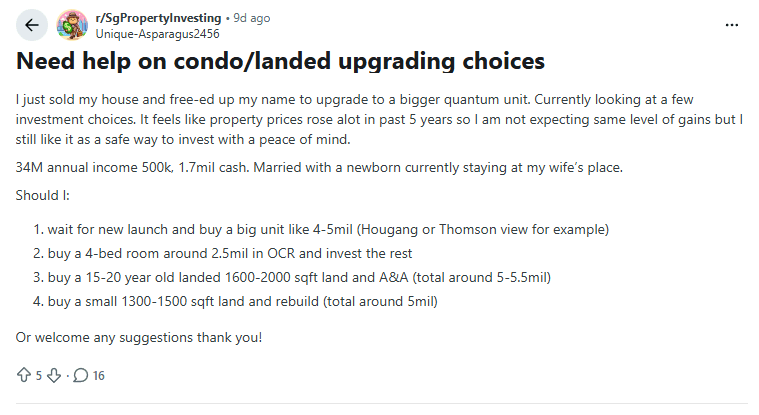
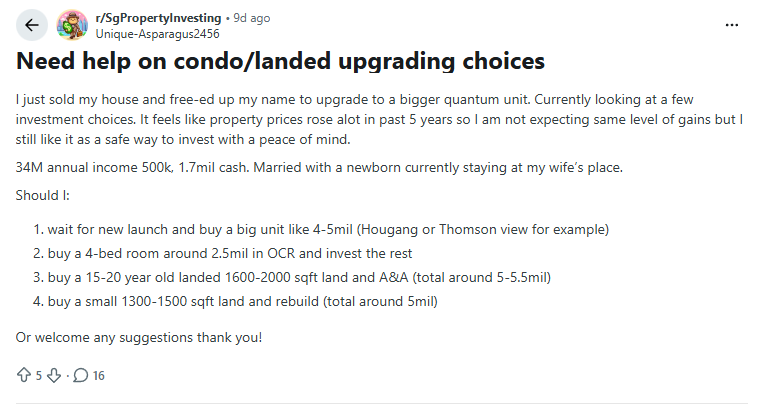
A 34-year-old on r/SgPropertyInvesting asked whether to spend his $1.7M cash and freed-up name on a $4-5M new launch, a $2.5M OCR 4-bedder, an A&A landed, or a small landed rebuild. Our answer is a D19 freehold corner terrace stretched to ~$6M. Developers paid $1,388 psf ppr for the Bayshore Road land bid in March 2025, and freehold corners in Serangoon Gardens transact at $2,057 psf on built-up. Adjusted for plot ratio, the landed buyer is essentially paying the developer's land cost, with the house thrown in.
Nine days ago, a Reddit user (handle Unique-Asparagus2456) posted on r/SgPropertyInvesting and compressed the most expensive decision most Singaporean households ever make into four options:
 Source: r/SgPropertyInvesting
Five upvotes, sixteen comments. Most of the replies pushed him toward Option 2, the safe diversification move. We'd answer Option 3, but not the version on the table.
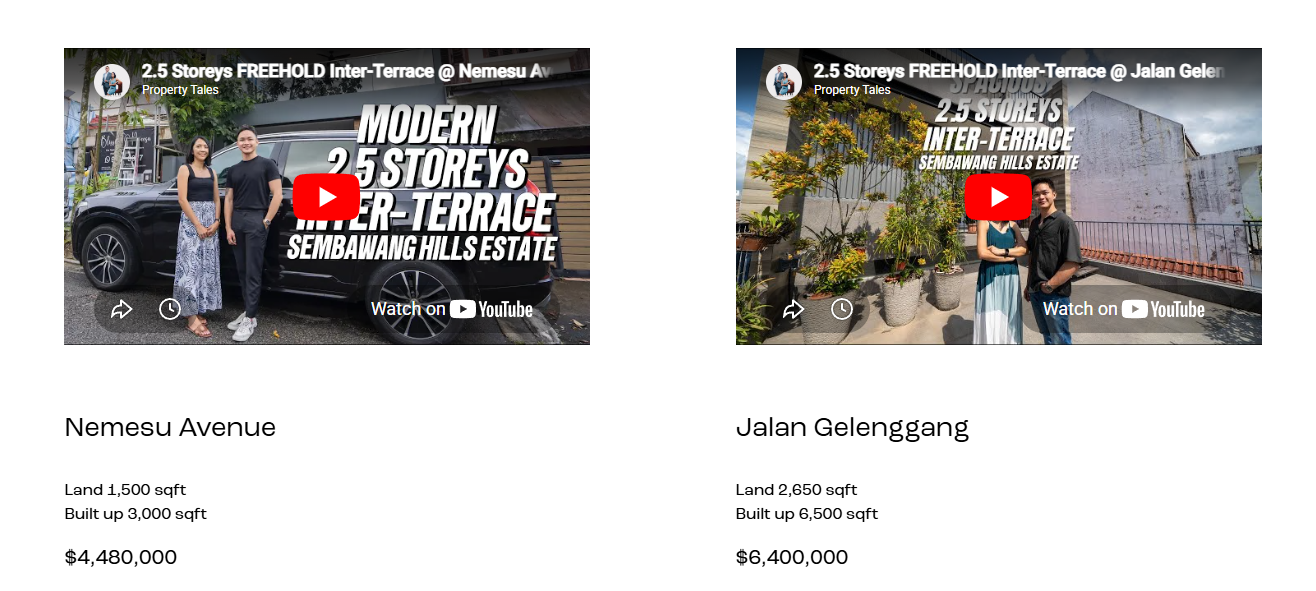
Before we walked through it, we wanted a sanity check from people who only sell landed. We sent the post to Clifton Liang and Shauna Seow at Property Tales SG, landed-only specialists based out of Sixth Avenue. Recent listings on their book span the exact slice the buyer is targeting: a $4.48M 1,500 sqft inter-terrace at Nemesu Avenue and a $6.4M 2,650 sqft inter-terrace at Jalan Gelenggang, both 2.5-storey freehold in Sembawang Hills Estate. Their take, woven through the option breakdowns below, lined up with ours, and sharpened two arguments we hadn't fully priced in.
 Source: Property Tales SG
Here's the case, walked through the way we'd walk through it.
What this buyer actually has working for him
Everything.
$500k household income puts him in the top 1-2% of Singapore earners. He can service a $4.5M mortgage without it dictating his life. His $1.7M cash means he doesn't need to max out LTV. He has flexibility on down payment size and renovation cashflow. He just freed his name, which is the most valuable piece of paper most couples ever hold, and it's clean. And the newborn is at his wife's place, which means he's choosing the next 15-20 years of his family's address, not panic-buying because he needs to move tomorrow.
This is a buyer who can afford the bigger move. The only question is whether he should make it. We think yes.

We agree.
Option 2: OCR 4-bedder + invest the rest. A good move, not the best one.
This is a defensible path. Many advisors would land here, and they wouldn't be wrong. He keeps cash on the side, takes less concentration risk, and buys into an asset class with real demand.
A $2.5M OCR 4-bedder works out to roughly $95k in BSD plus $25k in legal and closing costs (URA tiered formula, no ABSD since he freed his name). $1M cash down + $1.5M loan at ~3.5% leaves him with ~$580k of his $1.7M cash to invest.
The 4-bedder is the largest unit type that still trades in volume. The price gap from a 4-bedder to anything bigger (5-bedders, dual-key, penthouses, landed) is large. Buyers stretching for space cluster at the 4-bedder size, which means a well-located one has a deep pool of upgraders to sell into when he exits. The margin to close on resale is real, and the demand-side cushion is genuinely there.
Where it loses to Option 3 is borrowed-money efficiency. A $5.5M landed property at 75% LTV gives him $4.1M of working capital growing at the land price rate. A $2.5M condo at 75% LTV gives him $1.9M. The condo-plus-stocks combo, after Singapore property tax friction (rental taxed, capital gains within four years taxed via SSD, no comparable borrowing capacity for stocks), grows at a lower effective rate than landed does on the same horizon. Singapore landed has historically been resilient through downturns and rewards long holds via fixed supply and structural land scarcity.
At a $500k income, he can carry the bigger landed mortgage without it dictating his life. The question is whether to put the borrowed capital against the asset with the deeper long-term upside. Option 2 will also profit. Option 3, for this specific buyer, stretches the same dollars further.
Option 1: New launch $4-5M. Modern living, with the lowest land-per-dollar.
There are real reasons buyers lean here first. Fresh build, no renovation drama, branded developer with a track record, modern layouts, modern facilities, full warranty, move-in ready for the newborn. Easier to maintain than landed, and a deeper resale pool when life changes. These aren't trivial benefits, and any of them can be the right reason to choose this path.
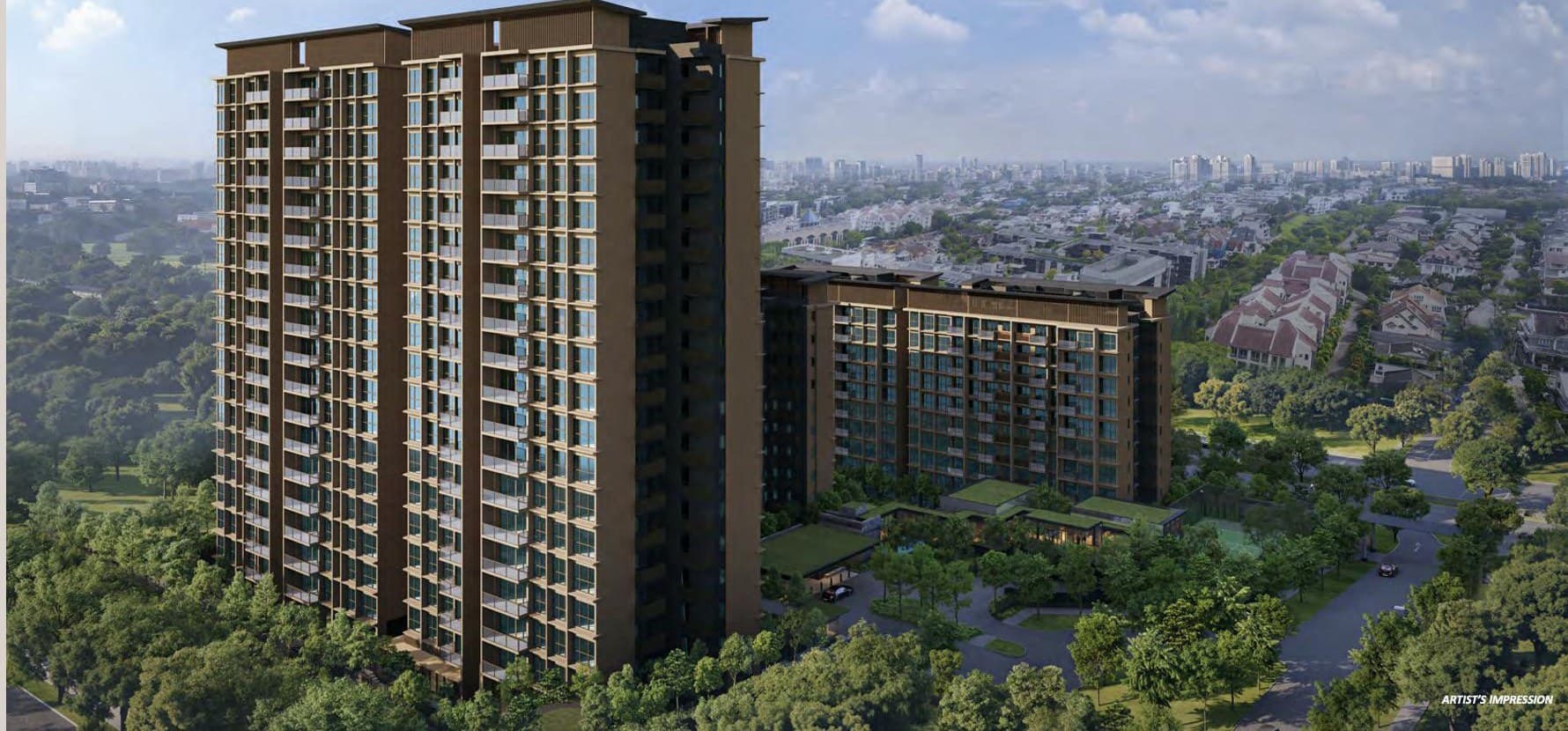
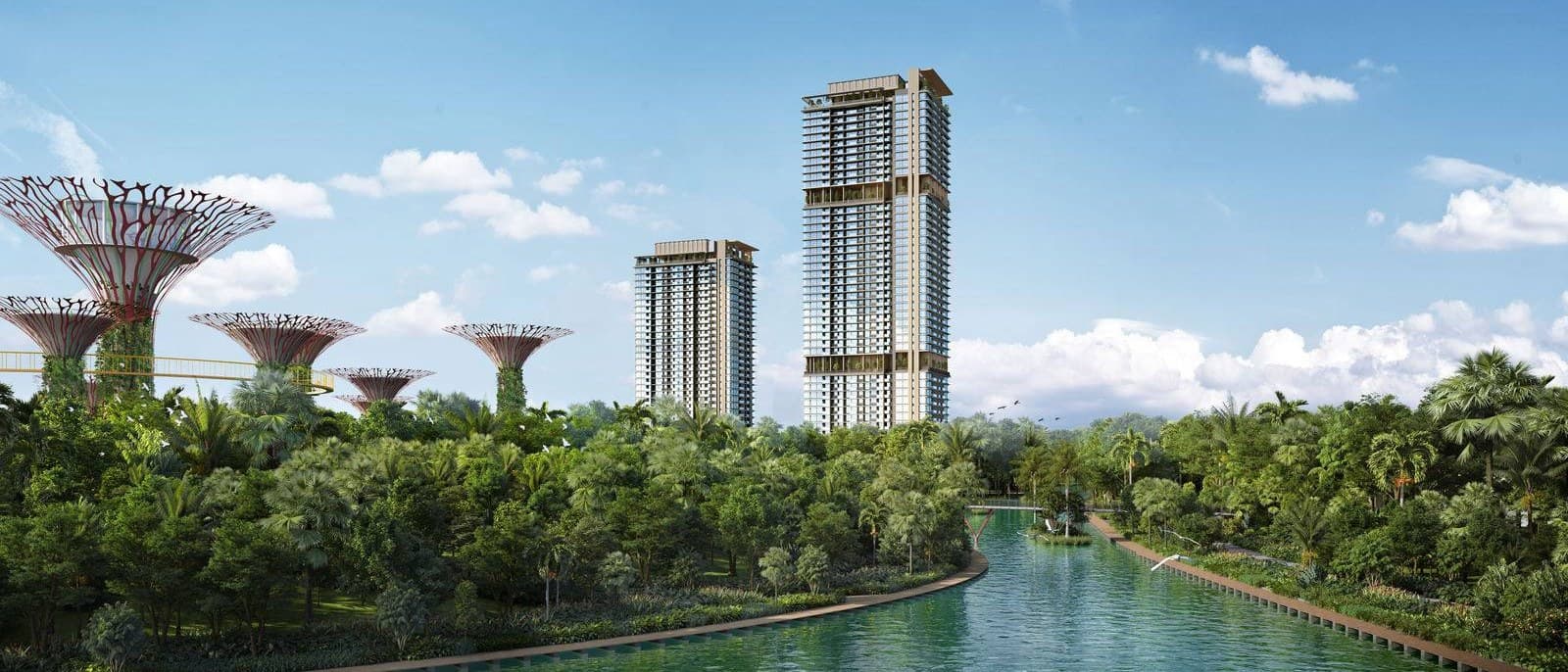
Take a hypothetical Hougang or Thomson View new launch at $4.5M. He'll get a 1,300-1,500 sqft 4-bedder at roughly $3,000-3,400 psf. The product is well-finished, the developer handles construction and the defects warranty, and resale demand at the 4-bedder size is deep.
Where it loses to Option 3 is on what he actually owns underneath. Slice the land beneath the unit by the OCR plot ratio (~3-3.5), and his share of raw land works out to roughly 350-450 sqft. A D19 freehold corner terrace in his budget gives him the whole plot, typically 2,000-3,000 sqft of land (URA caveats via EdgeProp). Same dollar, roughly 5-8x more land area than the new launch.
If lifestyle quality and exit speed are his priorities, Option 1 is a clean answer. If owning the land is the play, Option 3 buys more of it for the same dollar.
Option 4: Small landed + rebuild. Right asset, harder execution.
Option 4 has the right thinking behind it. He's buying land, which is the asset that gains when GLS prices climb. The challenge is execution, and on a small plot the execution is unusually hard.
Rebuild on 1,300-1,500 sqft means demolishing whatever's there, getting URA approval (typically 6-12 months for a clean rebuild, longer if there are setback issues or party-wall complications on a small plot), then 18-24 months of construction (Hitomo Construction rebuild guide 2025). He's looking at 30-36 months from purchase to keys.
During those 30+ months he's paying mortgage on the land, paying rent or imposing on his in-laws, and not building the family memory of "home" with a newborn-becoming-toddler. That cost doesn't show up in spreadsheets but it's real.
Property Tales added a wrinkle we hadn't sharpened. A buyer in this slot rarely starts demolition the week after completion. Between architect selection, planning submissions, and contractor mobilisation, the realistic build-start is closer to year two. Which means he has to rent the existing single-storey house out in the interim. Single-storey landed rental yields are the weakest slice of the segment. He's carrying mortgage on a property whose rental income won't cover the holding cost, just for the privilege of tearing it down later.
Small-plot rebuilds also carry the highest cost-per-sqft on the market. Without economy of scale, construction sits at the upper end of the $300-500 psf BCA-aligned range — often $400-500+ psf on small plots versus ~$300-350 psf on bigger ones, because fixed costs (architect, structural engineer, contractor mobilisation) get spread across less GFA. He'd be doing the most expensive version of the right idea.
And the land itself is the wrong slice. The 1,300-1,500 sqft plot is the smallest landed footprint that still trades on the open market, and it's the least sought-after. Buyers stretching into landed at this price tier are reaching for space, not contracting into it. The eventual exit pool is families wanting 2,000+ sqft of land or builders chasing yield on bigger plots. The small plot sells slowest and discounts hardest.
Option 3: 15-20 year old landed + A&A. The winner, with one tweak.
He had it right. We'd just push the budget slightly and tighten the location: a freehold corner terrace in D19, or the adjacent D20 freehold pockets, stretched to ~$6M if he can.
Four reasons.
Freehold matters for the long hold. When he goes to A&A in 8-10 years (most landed owners do A&A twice in a hold cycle), freehold doesn't add lease-decay anxiety to the renovation math. 999 is fine. 99 makes the second-A&A economics worse every year you hold.
D19 and the adjacent D20 freehold belt are the right slice for his budget. Pure freehold landed terraces with 2,000-3,000 sqft of land in his price range cluster in Serangoon Gardens, Kovan, and the freehold pockets running through Sembawang Hills Estate and Upper Thomson. CCR freehold landed starts at $8M+. D14 and D15 freehold terraces typically start at $7M+. D19 and the D20 Thomson belt are where his budget actually buys what he wants.
Then there's corner versus intermediate. Corner terraces typically carry meaningfully more land than intermediate units in the same row — often 30-50% more (PropertyGuru and 99.co listings consistently show this) — while the price premium is usually smaller, around 20-25%. He gets more land for each marginal dollar. Corners also typically have a side gate, better natural light, and the flexibility to extend on two sides during A&A.
Finally, the base needs to be 2-storey, not single-storey. A&A on a 1-storey shell means rebuilding any second floor from scratch, which fights setback rules and adds months to the build. A 2 or 2.5-storey base reuses the existing walls and foundation. Faster, cheaper, and the buyer can move in earlier. A good example is Property Tales' Jalan Gelenggang listing: $6.4M, 2,650 sqft of land, 2.5 storeys, 6,500 sqft built-up, freehold.
 Source: Property Tales SG
What's actually transacting in D19 right now: Serangoon Garden Estate's last 12 months of caveats cleared between $1,131 psf and $3,207 psf, averaging $2,057 psf on built-up area, with the highest recorded at $3,207 psf in September 2025 for a 1,840 sqft unit (URA caveats via EdgeProp). The spread tells him there's room to negotiate hard on the right plot, and to walk away from the wrong one.
If he can stretch to $6.0-6.3M, he opens up bigger corner plots (2,500-3,000 sqft of land), better-condition 1990s/2000s builds that need lighter A&A, and the quieter cul-de-sacs off Serangoon Garden Way. Stretching $500k upfront probably saves him $400-600k in renovation cost later. The older the build, the heavier the A&A scope.
Why old freehold landed is more affordable
Most "buy a condo and invest the rest" advisors miss the supply-side argument.
OCR land prices have jumped sharply.
| Site | Year | Winning bid | What it means |
|---|---|---|---|
| Lentor Modern (Lentor Central) | July 2021 | $1,204 psf ppr | Record OCR at the time, GuocoLand |
| Bayshore Road | March 2025 | $1,388 psf ppr | New OCR record, SingHaiyi/Haiyi |
| Lentor Central (second parcel) | March 2026 | $1,278 psf ppr | Five bidders, GuocoLand consortium |
Recent OCR launches (Lentor Modern, Tengah Garden, Pinery Residences) have cleared in the $2,100-2,800 psf range, and the next wave of OCR launches on land bid at $1,278-1,388 psf ppr will likely price meaningfully higher (EdgeProp 1H2026 GLS coverage). That sets the supply-side floor for any new product in his target regions: Hougang, Thomson, Bishan, Lentor, Bayshore.
Now ask the question that the advisors don't: what happens to the freehold landed sitting next door?
A freehold corner terrace in Serangoon Gardens transacts at roughly $2,057 psf on built-up area (URA caveats, 12-month average). For a 2-storey terrace, the underlying land works out to a similar order-of-magnitude as what developers just paid for the Bayshore Road site at $1,388 psf ppr, once you adjust for plot ratio. And the developer still has to add ~$1,200+ psf of construction (BCA-aligned industry data) plus profit margin, GST, marketing, and agent commission on top. The freehold landed buyer is essentially buying land near the developer's land cost, with the house thrown in.
Supply-side, landed is effectively fixed inventory. URA's 1H2026 Government Land Sales programme released nine confirmed sites — all condo, EC, or mixed-use, with no landed plots (URA Land Sales). Landed GLS releases happen occasionally but are extremely rare; the vast majority of landed inventory turns over between existing owners. Roughly 5% of Singapore's housing stock is landed, and a small subset of that is freehold. Demand is rising: permanent residency, citizenship, high-net-worth migration, and the slow generational hand-down within established Singaporean families.
If the GLS land floor keeps rising, every freehold landed plot in the country gets pulled up with it. Fixed supply, rising floor, and a price gap to close.
The case for landed isn't a lifestyle pitch. It's that the land is more affordable than what developers are now paying for adjacent land, and that gap closes over time.
What it actually costs him
Stretch case: $6.0M D19 freehold corner terrace, 2,500 sqft of land, 2,200 sqft of floor area, 1990s build, moderate A&A.
| Cost line | Amount |
|---|---|
| Purchase price | $6,000,000 |
| BSD | $299,600 |
| Legal, valuation, closing costs | ~$25,000 |
| Cash close (25% down + costs, $4.5M loan) | ~$1.82M |
| A&A (moderate scope, 2,200 sqft built) | $400,000–$700,000 |
| Architect + PE fees (~10% of A&A) | $40,000–$70,000 |
| Soft costs and submissions | $40,000–$80,000 |
| Total all-in | $6.5M–$6.9M |
Methodology: BSD computed exactly from URA's tiered formula (1% / 2% / 3% / 4% / 5% / 6% on each tier). A&A range assumes moderate scope on 2,200 sqft built-up at $180-300+ psf — the lower end of BCA-aligned construction benchmarks of $300-500 psf for full builds. Architect + PE fees at standard 8-12% of construction. Soft costs (URA submissions, structural drawings, surveyor, professional engineer reports) vary widely.
His $1.7M cash plus accessible CPF covers the close. A&A he can fund from cashflow: at $500k household income, $500-700k of renovation is roughly 1.0-1.4 years of post-tax earnings. He doesn't need to sell stocks or break SRS. The mortgage on $4.5M at a 4% stress rate runs ~$21,500/month, comfortably inside MAS's 55% TDSR ceiling on his gross household income.
A&A timeline is 12-18 months. He stays at his wife's place during the build, which he was going to do anyway.
Compare that path to Option 4 (small-plot rebuild): same all-in dollars, but 30-36 months to keys and a meaningfully smaller plot when it's done. Compare it to Option 2 (OCR 4-bedder + invest rest): he saves $3.5M upfront and invests the difference. At 7% compounded over 10 years, that $3.5M becomes ~$6.9M, which is a real outcome and not a small one. The same horizon at a 4% land appreciation rate (conservative given the GLS trajectory) takes a $6M D19 freehold landed to ~$8.9M, and he's been living in it the entire time with capital gains untaxed on own-occupation.
Both Option 2 and Option 3 land him in seven-figure profit territory over a long hold. Landed comes out further ahead the longer he holds, and the gap widens with time.
What he does this week
-
Get pre-approval for $4.5M. With $500k income and clean credit, this is a 48-hour conversation with a private banker. He wants the letter in hand before any viewings.
-
Engage two D19 landed agents in parallel. One specialised in Serangoon Gardens, one in Kovan/Hougang freehold pockets. Brief: freehold corner terrace, 2,200-3,000 sqft of land, 1990s build minimum, $5.5-6.5M, willing to stretch to $6.5M for the right plot.
-
Talk to two A&A architects before any offer goes in. Not contractors — architects. A 30-minute walkthrough on each shortlisted property tells him whether his renovation budget is real or fantasy. He's going to learn more from those four hours than from any agent's pitch.
-
Decouple cleanly with the wife. He buys solo. Her name stays clean for a future second property without triggering ABSD on the new place. The whole point of just freeing his name was to play this game well. He should keep the household's flexibility intact, not collapse it on day one.
-
Don't rush. The right freehold corner terrace in D19 doesn't list every week. Six months of disciplined searching usually saves $300-500k versus the first-listing reflex. The buyer who can wait wins this segment.
The Reddit poster asked which option is best. All four are real moves, and a thoughtful buyer can build a defensible case for any of them. Here's how we'd rank them for this specific buyer:
-
Option 3 — D19/D20 freehold corner terrace + A&A, stretched to ~$6M. Highest borrowed-money efficiency. Land trades at the biggest gap to what developers are paying next door. Livable from day one, 12-18 month renovation timeline. Our pick.
-
Option 2 — $2.5M OCR 4-bedder + invest the rest. Strong demand-side cushion. The 4-bedder slot has the deepest upgrader pool because the price gap to anything bigger is large. Lower concentration risk than landed, and a clean diversification path.
-
Option 1 — $4-5M new launch. Modern living, branded developer, no renovation drama, faster exit liquidity. Lowest land-per-dollar of the four, but everything else is clean and the product is move-in ready.
-
Option 4 — Small-plot rebuild on 1,300-1,500 sqft. Right asset class, hardest execution. 30-36 month build timeline, single-storey shell limits A&A flexibility, smallest landed footprint sells slowest on exit. We'd push him out of this slot into Option 3.
Across a 15-year hold, the gap between Option 3 growing at the GLS-implied land rate and Option 2 growing at the new-condo absorption rate is a seven-figure swing, on top of what either option already delivers on its own.
Land is the asset for a buyer who can afford it. He's in the right window. He should buy as much of it as his finances allow.
This is general analysis based on a public Reddit post on r/SgPropertyInvesting. Every buyer's tax position, mortgage capacity, family timing, and risk tolerance differs. Speak to a qualified property practitioner before committing to a $5M+ purchase.